Penang punches well above its weight for a Malaysian state of around 1.8 million people. Georgetown, the capital, earned UNESCO World Heritage Site status in 2008 for the intactness of its colonial-era shophouse streetscapes, Chinese clan temples and colonial administrative buildings. Layer on top of that Malaysia’s most celebrated food scene, one of Southeast Asia’s most talked-about street art collections and a cable car to a hilltop colonial hill station — and you have a destination that rarely disappoints. Below are the tours and experiences worth building a Penang visit around, with current prices and what each one actually involves.
Georgetown Street Art and Heritage Walk
The street art scene in Georgetown is the work of several artists, but the one most associated with the city is Lithuanian painter Ernest Zacharevic, who created a series of interactive murals in 2012 for the Penang Heritage Trust. The most photographed — children on a real bicycle mounted to the wall, a boy on a motorcycle in a sidecar — are on Armenian Street and nearby lanes, and the locations are marked on free maps available from the Penang Global Tourism office on Jalan Penang.
A guided heritage walk adds context that the art alone does not supply: the 19th-century Malay, Chinese and Indian communities who built these streets; the specific clans behind the kongsi (clan house) complexes like Cheah Kongsi (Lebuh Armenian) and Khoo Kongsi (Cannon Square, the grandest of them all); and the British colonial administrative layer visible in the Fort Cornwallis and the Eastern & Oriental Hotel.
A 3–4 hour guided tour typically covers:
- Armenian Street murals (Zacharevic’s best-known works)
- Cheah Kongsi and Khoo Kongsi — clan halls with ornate southern Chinese architecture
- Sri Mahamariamman Temple on Jalan Masjid Kapitan Keling — among the oldest Hindu temples in Penang
- Little India on Jalan Pasar — textiles, jasmine garlands, Tamil gold jewellery
- Fort Cornwallis — the 1786 British fort at the northeastern tip of Georgetown
Prices: guided heritage walks cost approximately RM 80–150 per person, with smaller groups (under 8 people) offering more time at each site. Self-guided walks using the free trail maps from Penang Global Tourism are free.
Penang Hill Funicular
At 821 m above sea level, Penang Hill (Bukit Bendera) offers the clearest elevated view of Georgetown and the Penang Strait. On a clear morning, you can see north toward the Kedah coast and south toward Butterworth across the water. The funicular railway — the steepest in Malaysia — covers 1.8 km and 700 m of elevation gain in around 6 minutes.
The hilltop has changed considerably over the past decade. The Owl Museum (approximately RM 25 entry) displays an eccentric collection of owl artefacts from around the world. The restored colonial bungalows near the summit, once private retreats for British administrators, house several restaurants including David Brown’s — a heritage building serving afternoon tea at approximately RM 55–75 per person that remains one of Penang’s most distinctive experiences.
The hilltop itself is cool — typically 5–8°C below Georgetown — with several short walking trails that wind through the forest to secondary viewpoints. The most rewarding is the 15-minute walk to the Habitat, a tree-canopy walkway (separate entry approximately RM 63 per adult) that extends 230 m through secondary jungle at the 1,000 m contour.
Funicular return tickets: approximately RM 30 per adult, RM 15 per child. Book online in advance — queues at the ticket office can run 45–60 minutes on weekends. The first car of the day (typically 6:30am) is the least crowded.
Combined Penang Hill + Kek Lok Si tours from Georgetown cost approximately RM 100–160 per person with transport and a guide.
Kek Lok Si Temple
Kek Lok Si in Air Itam is the largest Buddhist temple complex in Malaysia and one of the most visually elaborate in Southeast Asia. Construction began in 1890 and has never fully stopped — the 30 m bronze Kuan Yin statue that dominates the upper terrace was only completed in 2002.
The complex ascends in tiers: the lower section is a covered bazaar of religious goods and food stalls; the middle tier has the seven-storey Pagoda of 10,000 Buddhas (Ban Po Thar), a distinctive Burmese-Thai-Chinese hybrid in architecture; the upper terrace holds the Kuan Yin statue surrounded by secondary shrines. Taking the cable car (approximately RM 8 return, open 8:30am–5:30pm) saves a 20-minute climb up the final hill.
At Lunar New Year (January–February), Kek Lok Si transforms: thousands of lanterns are hung across the lower complex, drawing large crowds. During this period, visit before 9am to avoid the worst congestion.
Entry to the main complex is free; the pagoda interior charges approximately RM 2. Budget 90 minutes minimum, 2 hours if you walk every level. Most guided Penang Hill tours include a stop here — it adds around 45 minutes to the itinerary.
Penang Street Food Tour
Penang’s food reputation is built on its hawker centres: the density of vendors, the depth of tradition (many recipes unchanged for three generations) and the fierce loyalty of locals to specific stalls over others. Asam laksa, char koay teow, cendol, hokkien mee, rojak — these dishes originated or were perfected here.
We have a full dedicated guide to Penang’s street food scene and best tours covering the specific hawker centres (Gurney Drive Hawker Centre, New Lane Hawker Centre on Jalan Macalister, Red Garden Food Paradise), which dishes to prioritise and what a guided food walk covers that self-guided exploring misses.
In short: an evening food walk starting at 7pm and ending around 10pm covers 5–7 tastings and costs approximately RM 150–200 per person including food. Daytime walks are possible but heat makes them harder work. Private tours for 2–4 people cost more but allow more plates and slower stops.
Cycling the Georgetown Heritage Zone
Georgetown’s core heritage zone is compact and mostly flat — around 1.5 km from the Fort Cornwallis waterfront to the inland clan house district — which makes it well-suited to cycling. Bicycle hire is widely available around the ferry terminal and Armenian Street for approximately RM 15–25 per day.
Guided cycling tours (2–3 hours, approximately RM 80–120 per person) follow routes that thread through the back lanes between shophouses where the street art is concentrated, crossing into the covered market district of Little India and ending at the waterfront promenade with views of Butterworth across the strait. These tours work best in the early morning (before 10am) when the lanes are quiet and the light on the heritage facades is at its most photogenic.
The key sites accessible by bicycle:
- Clan Jetties (Weld Quay) — wooden stilt villages extending into the harbour; the Chew Jetty is the most visited, with temples, ancestral homes and souvenir shops
- Kapitan Keling Mosque — built by Indian Muslim traders in 1801, now a landmark on Jalan Masjid Kapitan Keling
- St George’s Church — the oldest Anglican church in Southeast Asia (1818), on Farquhar Street
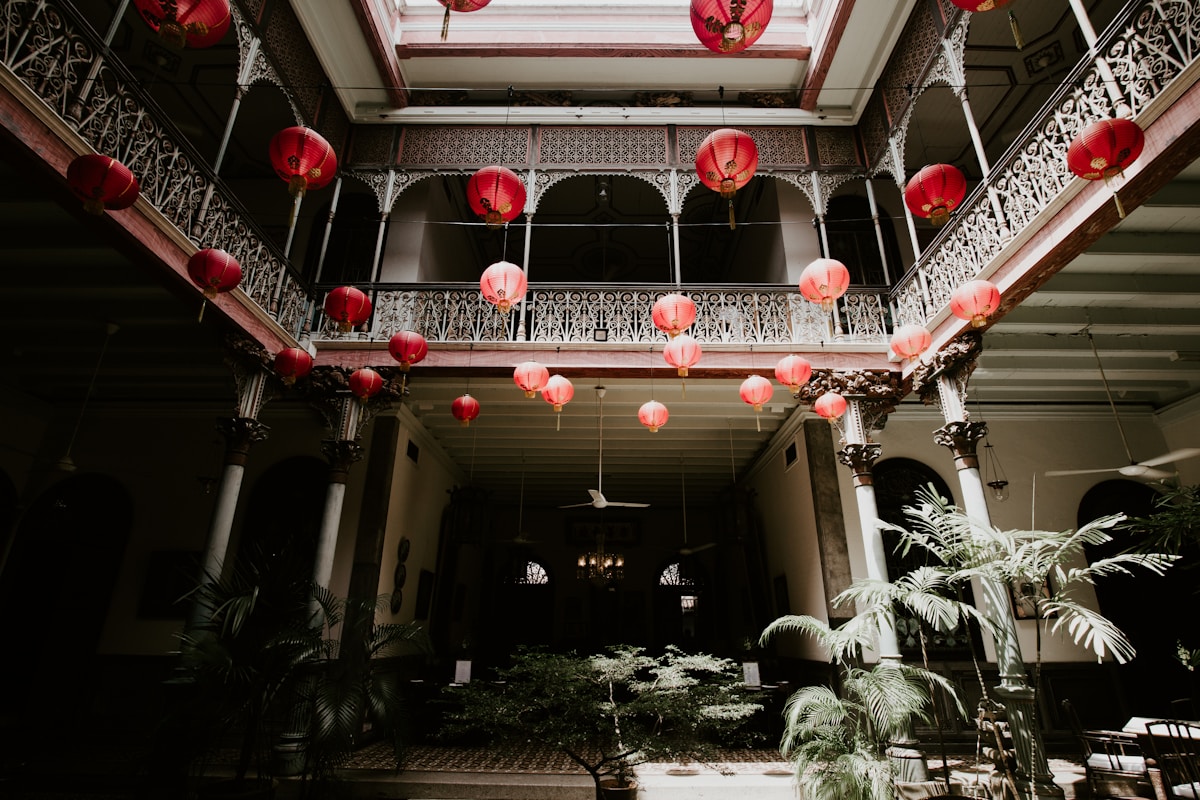
- Blue Mansion (Cheong Fatt Tze Mansion) — a cobalt-blue 38-room Straits Chinese mansion built in the 1890s; guided tours approximately RM 17 per adult
Practical Tips for Penang Tours
Getting to Penang: Penang International Airport has direct connections from KL Sentral by AirAsia and Malaysia Airlines (approximately 1 hour) and from Singapore. The Penang Ferry from Butterworth (RM 1.20 one way) is the classic arrival approach from the mainland, with Georgetown’s Clan Jetties visible from the water.
Getting around Georgetown: Most heritage sites are within walking distance of each other. Trishaws (three-wheeled cycle rickshaws) operate around Fort Cornwallis and cost approximately RM 20–30 per hour. Grab taxis work well for the Penang Hill and Kek Lok Si segment, which sits 5 km from the Georgetown waterfront.
Best time to visit: November to February (northeast monsoon season) brings occasional heavy rain to the east coast, but Georgetown on the northwest coast of the island is relatively sheltered. April and May are the driest months. Avoid Chinese New Year if you are not specifically there for the lantern festival — hotel prices double and Kek Lok Si is extremely crowded.
What to wear: Light clothing throughout. Temple visits require covered shoulders and knees — small sarongs are available to borrow at most sites. Comfortable flat shoes are essential; Georgetown’s five-foot ways (covered walkways in front of shophouses) have uneven surfaces.
For a longer stay, our Penang where to stay guide covers the Georgetown heritage zone hotels, Batu Ferringhi beach options and mid-range guesthouses in the shophouse belt. Browse current Penang tour options on GetYourGuide to compare small-group and private tour operators before booking.