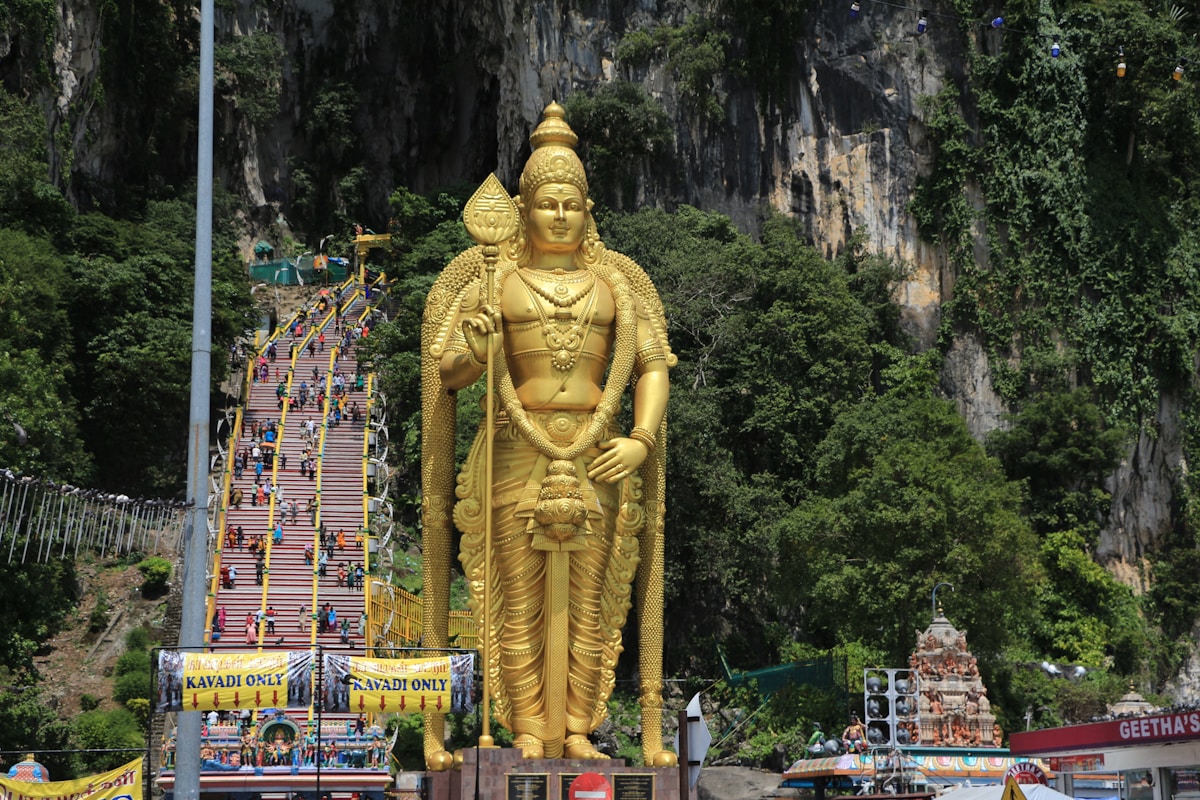
Batu Caves is a limestone hill complex 13 km north of Kuala Lumpur containing a network of caves and Hindu temples. The site has been a place of worship since 1891 and is now the most visited non-urban attraction in Malaysia. The 42.7-metre golden statue of Lord Murugan at the entrance is one of the tallest statues of a Hindu deity in the world, and the 272 rainbow-painted steps behind it lead to Cathedral Cave, an active temple set inside one of Southeast Asia’s most spectacular natural chambers.
What You’ll Find at Batu Caves
The site consists of three main areas accessible to visitors: the main staircase and Cathedral Cave, the Dark Cave (a separate geological attraction requiring a paid tour), and the Ramayana Cave and Art Gallery on the lower level.
Cathedral Cave is the centrepiece. At the top of the 272 steps, the cave opens into a chamber roughly 100 metres high. Natural light enters through a gap in the limestone ceiling, illuminating several Hindu shrines dedicated to Lord Murugan, son of Shiva and a central deity in Tamil Hinduism. The cave is an active place of worship - devotees make offerings here year-round, and puja ceremonies take place several times daily. Macaques are present throughout the complex; keep food in sealed bags and do not feed them.
Dark Cave branches off from Cathedral Cave and extends for roughly 2 km into the hill. It hosts 23 species unique to this cave system, including the trapdoor spider and cave racer snake. Guided educational tours run in 45-minute sessions and require pre-booking - book through the Dark Cave website or at the entrance; adventure caving packages (approximately RM150–200 per person as of 2026) go deeper into the system with a smaller group. Entry to Dark Cave is completely separate from Cathedral Cave and requires a ticket.
Ramayana Cave is on the ground level, to the right of the main staircase. A different tunnel passes through illuminated dioramas depicting scenes from the Hindu epic Ramayana. Entry is approximately RM5 per person as of 2026. It takes about 20 minutes to walk through and is considerably cooler than the exposed staircase.
The 272 Steps
The staircase is the defining image of Batu Caves. Each riser is painted in a different colour - the rainbow effect was added when the steps were renovated in 2018 - and the full climb from ground level to the Cathedral Cave entrance takes 15–25 minutes at a comfortable pace.
The steps are steep rather than long. Most visitors find the descent harder on their knees than the ascent. There is no lift or ramp alternative. During peak visiting times on weekends, the steps become crowded enough that the effective pace is set by the crowd, not by you. Wearing shoes with grip is advisable - the stone can be damp near the top where the cave interior keeps moisture in.
Monkeys are present on the steps and particularly bold around food. Bottles with lids are generally fine; open snacks invite trouble.
Getting to Batu Caves from KL
By train is the easiest option. The KTM Komuter Batu Caves line (also called the Rawang–Batu Caves line) departs from KL Sentral, Kuala Lumpur station, and Bank Negara station among others. The journey from KL Sentral takes approximately 30–35 minutes. Trains run every 30 minutes during most of the day; check the KTM website for the current timetable. A single ticket costs approximately RM3–4 as of 2026. Batu Caves KTM station is a five-minute walk from the cave entrance.
By Grab the journey from Bukit Bintang or KLCC typically takes 25–40 minutes depending on traffic and costs approximately RM20–35 one way. Traffic on the Federal Highway northbound can be slow during rush hours (7am–9am, 5pm–8pm on weekdays).
By bus RapidKL bus routes 11 and 11D connect the city centre to Batu Caves; the journey is longer than the train (45–60 minutes) but costs less. Check the MyRapid app for real-time departures.
There is car parking at the site, but it fills quickly on weekends. Arriving by train avoids this entirely.
Dress Code and Temple Etiquette
The cave temples are active places of Hindu worship, and the rules are straightforward: shoulders and knees must be covered inside the cathedral and inner shrines. Shoes must be removed before entering the main shrine at the top.
Sarongs can be borrowed or rented at the entrance for approximately RM5–10 if you arrive in shorts or sleeveless clothing. The enforcement point is typically at the inner shrine entrance at the top, not at the base of the steps. Arriving underdressed means climbing 272 steps and then being asked to cover up or turn back - rent the sarong before you start.
Photography inside the inner shrines is at the discretion of the priests on duty; ask before raising a camera near an active altar.
Thaipusam at Batu Caves
Thaipusam is a Tamil Hindu festival observed on the full moon of the Tamil month of Thai, which typically falls in January or February on the Gregorian calendar. Batu Caves is the focal point of Malaysian Thaipusam: over one million people converge on the site over approximately 36 hours, making it one of the largest Hindu gatherings outside India.
The festival honours Lord Murugan. The most visible act of devotion is the carrying of kavadi - large, ornate frames decorated with peacock feathers, flowers, and fruit, held in place by metal skewers piercing the skin. Devotees prepare for months through fasting, prayer, and ritual purification before they pierce. The silver chariot carrying the deity’s image is pulled by devotees from Sri Mahamariamman Temple in KL’s Chinatown through the night, arriving at Batu Caves in the early morning hours.
Witnessing Thaipusam is a genuine and profound experience. Practically, it requires planning: the entire area is at capacity, train services run through the night but trains are extremely crowded, and roads within several kilometres of the site are closed to private vehicles. If you want to attend, take the overnight KTM Komuter from KL Sentral, arrive by 3am–4am, and expect a full day. The festival is not a spectacle designed for tourists - it is a religious observance - so conduct yourself accordingly.
Practical Information
Opening hours: The grounds and Cathedral Cave are accessible from roughly 6am to 9pm daily. The inner temple shrines have their own hours for puja, typically 8am–12pm and 4pm–9pm.
How long to allow: 1.5 to 2 hours covers the main staircase, Cathedral Cave, and Ramayana Cave comfortably. Adding Dark Cave extends the visit to 3 hours.
What to bring: Water (the climb in Malaysian heat is dehydrating), covered clothing or a lightweight layer to put on at the top, and cash for the Ramayana Cave ticket and optional donation.
Combined with KL day trips: Batu Caves pairs well with a visit to the Forest Research Institute Malaysia (FRIM) in Kepong or the Royal Selangor Visitor Centre, both reachable in under 30 minutes from Batu Caves station. Most visitors combine a morning at Batu Caves with an afternoon in central KL.
Batu Caves Tours on GetYourGuide
Most visitors come to Batu Caves independently, but guided tours are worth considering if you want to combine the caves with other KL attractions in a single day without managing transport. The following are available on GetYourGuide with free cancellation on most; prices in USD as of 2026.
- Batu Caves & City Highlights Half-Day Tour (3.5 hrs) — from $23 per person. Guided visit to the Rainbow Staircase and Cathedral Cave, plus photo stops at the Petronas Towers, National Mosque, and Merdeka Square. Hotel pickup included on most options. Recommended for first-time visitors who want Batu Caves as part of a broader KL orientation.
- KL Half-Day Tour with Batu Caves, Batik & Pewter (4.5 hrs) — from $28 per person. Adds a demonstration at a Batik art studio and the Royal Selangor Pewter centre to the standard Batu Caves visit; good if you want craft context alongside the temple.
- KL Tour with 10 Attractions including Batu Caves (4 hrs) — from $31 per person. Broader city sweep including Chinatown, the King’s Palace, and Central Market alongside the caves; small-group format with a local guide.
- Private KL City Tour with Batu Caves & Petronas Towers (5–6 hrs) — from $65 per person. Private vehicle with a dedicated driver-guide; flexible itinerary, useful for families with children or travellers wanting to set their own pace.
[Browse Kuala Lumpur tours on GetYourGuide →](/go/tours-kuala-lumpur) | Get a Malaysia eSIM
Related Guides
- Kuala Lumpur travel guide - full KL guide covering Batu Caves transport, Petronas Towers, and the best neighbourhoods to base yourself
- Things to do in Kuala Lumpur - Batu Caves in context with other KL highlights: KL Tower, Islamic Arts Museum, and Chinatown
- Day trips from Kuala Lumpur - Batu Caves, Putrajaya, Malacca, and Genting Highlands as day trips from KL
- Kuala Selangor day trip - another popular KL day trip: Sky Mirror sandbar, Bukit Melawati, and fireflies on the Selangor River
- 3-day Kuala Lumpur itinerary - how to fit Batu Caves into a 3-day KL trip with the Petronas Towers and Islamic Arts Museum
- Last-minute Malaysia tours - same-day and short-notice guided tours available in and around Kuala Lumpur