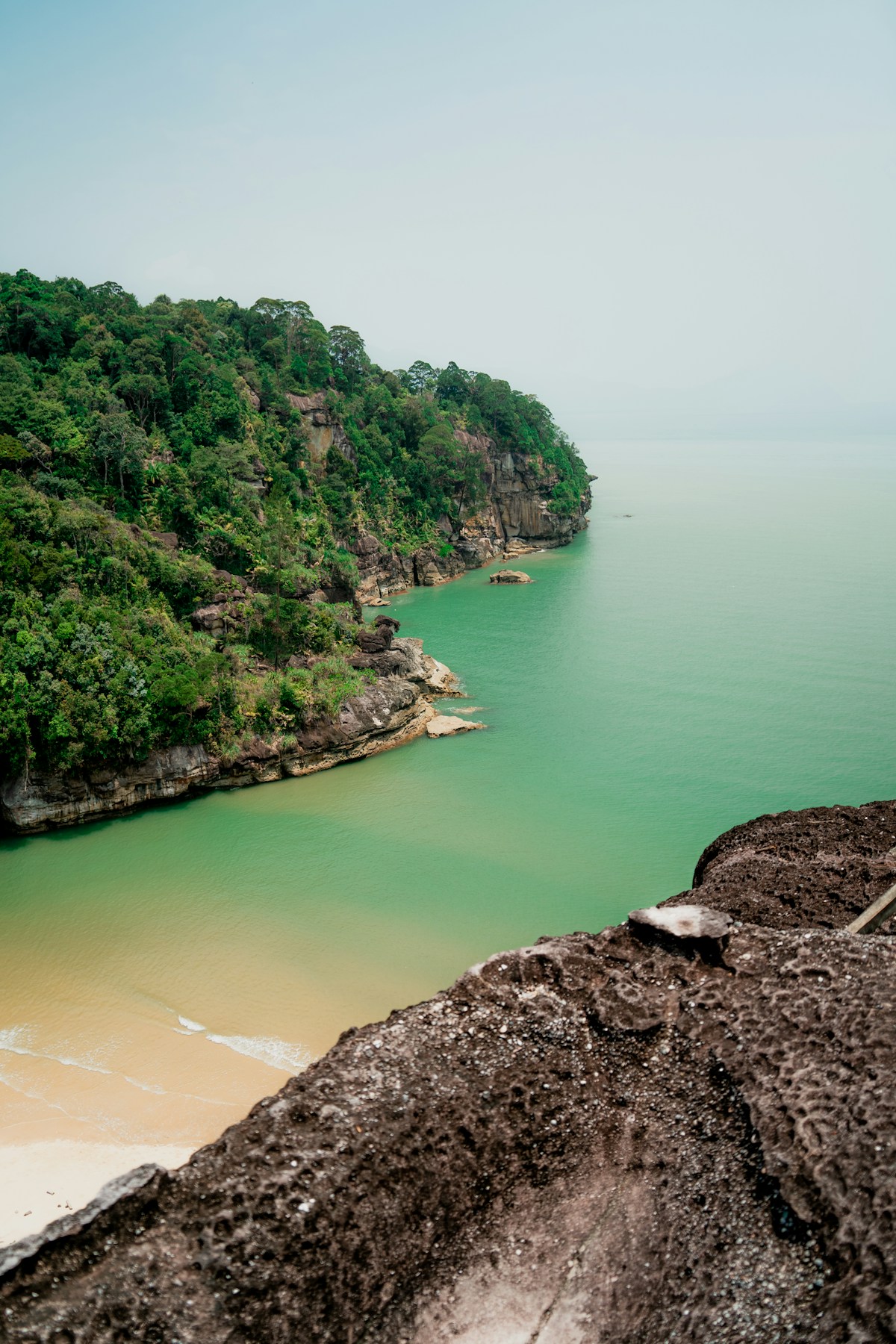
Bako National Park is Sarawak’s oldest national park and one of the most accessible pieces of Borneo’s rainforest. Established in 1957, it covers 2,728 hectares of peninsula jutting into the South China Sea northeast of Kuching. The park packs an extraordinary range of ecosystems into a small area: mangrove forests along the shore, lowland rainforest in the valleys, heath forest (kerangas) on the sandstone plateau, and sea cliffs sculpted into stacks and arches by wind and wave. Most visitors come specifically for proboscis monkeys, and Bako reliably delivers - but the trails, the beach scenery, and the sheer density of wildlife make it worth at least a full day and ideally an overnight stay.
Getting to Bako National Park from Kuching
The journey requires two stages: road to Kampung Bako, then boat to the park.
By bus: Bus 1 departs from Kuching Open-Air Bus Terminal and runs to Kampung Bako village approximately every 30–60 minutes from around 7am. The journey takes 45–60 minutes and costs approximately RM4–6 as of 2026. From Kampung Bako, the park is a 20–30 minute boat ride.
By taxi or Grab: A private taxi or Grab from Kuching city centre to Kampung Bako takes about 40–50 minutes and costs approximately RM40–60 depending on the route and traffic. This is faster and more convenient for groups.
Boat transfer at Kampung Bako jetty: Once at the village jetty, you hire a wooden longboat to park headquarters (Telok Assam). The fare is per boat, not per person - approximately RM60–100 per boat one way as of 2026. Most boats carry 4–8 people, so independent travellers can often share with others arriving at the same time. The crossing takes 20–30 minutes in calm conditions; rough seas can make it longer or occasionally impossible. Always confirm your return boat time with the operator before departure - boats do not wait once you’re on the trails.
Named operators: Bako Water Taxi and several independent operators work from the Kampung Bako jetty. Your guesthouse or hotel in Kuching can arrange the transfer, and some Kuching-based tour operators (including Borneo Adventure, CPH Travel, and Sticky Rice Travel) offer day tour packages that include transport, the boat, and a guide.
Park Entry and Registration
All visitors must register at the park headquarters (Telok Assam) on arrival. Entry fees as of 2026 are approximately RM20 for foreign adults and RM7 for foreign children; Malaysian citizens pay lower rates. Professional camera fees apply. Pay at the counter and retain your receipt - rangers check it on trails.
Overnight accommodation must be booked in advance through the Sarawak Forestry Corporation booking system at ebooking.sarawakforestry.com. The park does not accept walk-in overnight bookings during busy periods. Day visitors do not need advance booking.
Proboscis Monkeys
Bako holds one of the most accessible wild populations of proboscis monkeys in Borneo. The distinctive large-nosed males (proboscis monkeys are the only primates where the male’s nose is substantially larger than the female’s) live in harem groups and are most visible feeding near the coast in the late afternoon.
The resident group near park headquarters typically appears between 4pm and 6pm, moving through the trees above the canteen area and along the coastal forest. This is the most reliable sighting in Bako, and it often requires no effort beyond sitting at the right time in the right place. A second group ranges along the Ulu Serait trail, though sightings there are less predictable.
Silvered langurs - metallic grey leaf monkeys with orange-tinted infants - are present throughout and easily seen near headquarters. Long-tailed macaques are everywhere, bold and persistent around food. Bearded pigs root through camp in the early morning. Bako also has a healthy population of long-tailed macaques, monitor lizards, and occasional sambar deer.
Keep 5–10 metres from all wildlife. Do not feed any animals - the macaques in particular have learned to associate visitors with food and will snatch bags.
The Trail System
Bako has 16 marked trails ranging from a 0.5-km stroll to full-day hikes. Trails are colour-coded; pick up the free trail map at park headquarters.
Lintang Loop (5.5 km, 3–4 hours): The park’s signature trail, passing through all seven of Bako’s vegetation types. Starts and ends at headquarters. The trail climbs to the sandstone plateau, crosses heath forest scrubland with pitcher plants and sundews, then descends through dipterocarp rainforest back to the coast. A complete picture of Bako’s ecosystems in one loop.
Telok Pandan Besar Trail (5.8 km one way, 3–4 hours each way): Leads to Bako’s most scenic beach - a crescent of sand beneath red sandstone sea stacks accessible only at low tide. The trail is moderate with some steep sections and root-covered ground. Check the tide table at park headquarters before setting out; the beach is only accessible at low tide, and you cannot linger if the tide is coming in. Turn back in time or you will be wading.
Telok Pandan Kecil Trail (3.5 km one way): Shorter version that leads to a smaller beach with sea arches carved into sandstone. Easier than the Pandan Besar trail.
Ulu Serait Trail (1.1 km): Short forest walk near headquarters with excellent birdwatching. Useful for early morning wildlife activity before starting a longer trail.
Bukit Gondol Trail (3.8 km one way): Reaches the highest point in the park with views across the South China Sea. Steep in sections. Combine with Lintang for a longer day.
Telok Limau Trail (11.1 km one way): A full-day undertaking, reached only on foot and requiring an overnight stay at Telok Limau’s basic shelter. Very few visitors complete this; prepare accordingly.
What to Bring
The trails at Bako can be demanding - muddy, steep, leech-infested after rain, and hot throughout the day.
Bring a minimum of 2 litres of water per person for any trail over 3 km. The park sells water at the canteen, but you will not want to run out on trail. Long-sleeved shirts and trousers protect against leeches and sun on the exposed plateau. Leech socks (available at outdoor shops in Kuching) slip over your shoes and prevent leeches from reaching your ankles. Waterproof trail shoes or hiking boots grip the clay-heavy trails far better than sandals.
There is no ATM in the park - bring cash for entry, food, and the return boat. The park canteen serves basic meals; if you plan a long trail, bring snacks. A headlamp is essential for overnight visitors and useful if any trail takes longer than expected.
Insect repellent should be reapplied every 2–3 hours in the jungle.
Accommodation at Bako National Park
Staying overnight changes the experience entirely. The park at dawn - before day trippers arrive on the first boats - belongs to wildlife.
Park accommodation is operated by the Sarawak Forestry Corporation and must be booked online in advance:
Dormitory beds: Approximately RM35–50 per person per night as of 2026, in shared 8-person dormitories with fan and shared bathrooms. Bring earplugs.
Budget chalets: Approximately RM150–200 per chalet per night, sleeping 2–4 people. Fan-cooled, attached bathroom, basic furniture. Clean and functional.
Standard chalets: Approximately RM200–300 per night. Larger, slightly better equipped. Some have air conditioning. Still basic compared to Kuching hotels.
Rest house: A larger unit suitable for families or groups, approximately RM300–400 per night.
All accommodation is at Telok Assam near park headquarters. The canteen serves breakfast from around 7am, lunch, and dinner - bring extra food if you’re particular about what you eat.
Book at least 2–4 weeks ahead for weekends; Malaysian school holiday periods require earlier booking still.
Practical Information
Opening hours: The park is open year-round. Boat transfers run from early morning until late afternoon; do not miss your return boat or you will be stranded overnight.
Best time: The dry season from March to October generally gives clearer skies and calmer boat crossings. November to February brings the northeast monsoon - heavier rain and rougher seas, though the park itself remains accessible most days. Wildlife is present year-round.
Guides: Hiring a park guide (approximately RM80–120 per half day as of 2026) significantly increases wildlife sightings. Guides know which trails the proboscis groups favour on any given day and can identify birds, pitcher plants, and other wildlife you would otherwise walk past.
Day trips vs overnight: A full day gives you time for the Lintang Loop, a proboscis sighting near headquarters, and the beach - but you’ll be back in Kuching by 6pm. An overnight stay adds the dawn wildlife window, access to the longer trails, and the particular atmosphere of a jungle park after dark.
Bako National Park Tours on GetYourGuide
Booking through GetYourGuide bundles the Kuching–Bako jetty transfer and boat crossing into a single confirmed price, which simplifies the logistics considerably (particularly arranging the return boat, which independent visitors sometimes miscalculate). Two formats are listed; both include hotel pickup from Kuching. Prices as of 2026 — confirm current availability when booking.
- Kuching: Bako National Park Day Trip (6 hrs, guided) — hotel pickup from Kuching to Bako jetty, boat transfer to park headquarters, guided hiking on the Lintang Loop or coastal trails, and wildlife spotting (proboscis monkeys, bearded pigs, silvered langurs). The guide fee, boat transfer, and transport are bundled — typically more cost-effective than arranging each component separately at the jetty. Park entry fee (approximately RM 20 for foreign adults) is paid on arrival.
- Kuching: Bako National Park 2-Day Wildlife Tour — overnight option with early morning and dusk wildlife sessions that a single day visit cannot cover. Includes accommodation at the park chalets. The dawn and dusk hours are when proboscis monkey activity peaks, and overnight stays allow access to the longer trails (Telok Limau, Telok Kruin) that are impractical as day trips.
[Browse Kuching and Bako tours on GetYourGuide →](/go/tours-kuching)
Related Guides
- Kuching travel guide - using Kuching as a base for Bako, Semenggoh, and Sarawak’s other wildlife sites
- Kuching wildlife guide - Semenggoh orangutans, proboscis monkeys, and hornbills within reach of Kuching
- Borneo wildlife guide - orangutans, pygmy elephants, and how wildlife watching compares across Borneo
- Best national parks in Malaysia - Bako in context with Gunung Mulu, Taman Negara, Kinabalu, and other Malaysian parks