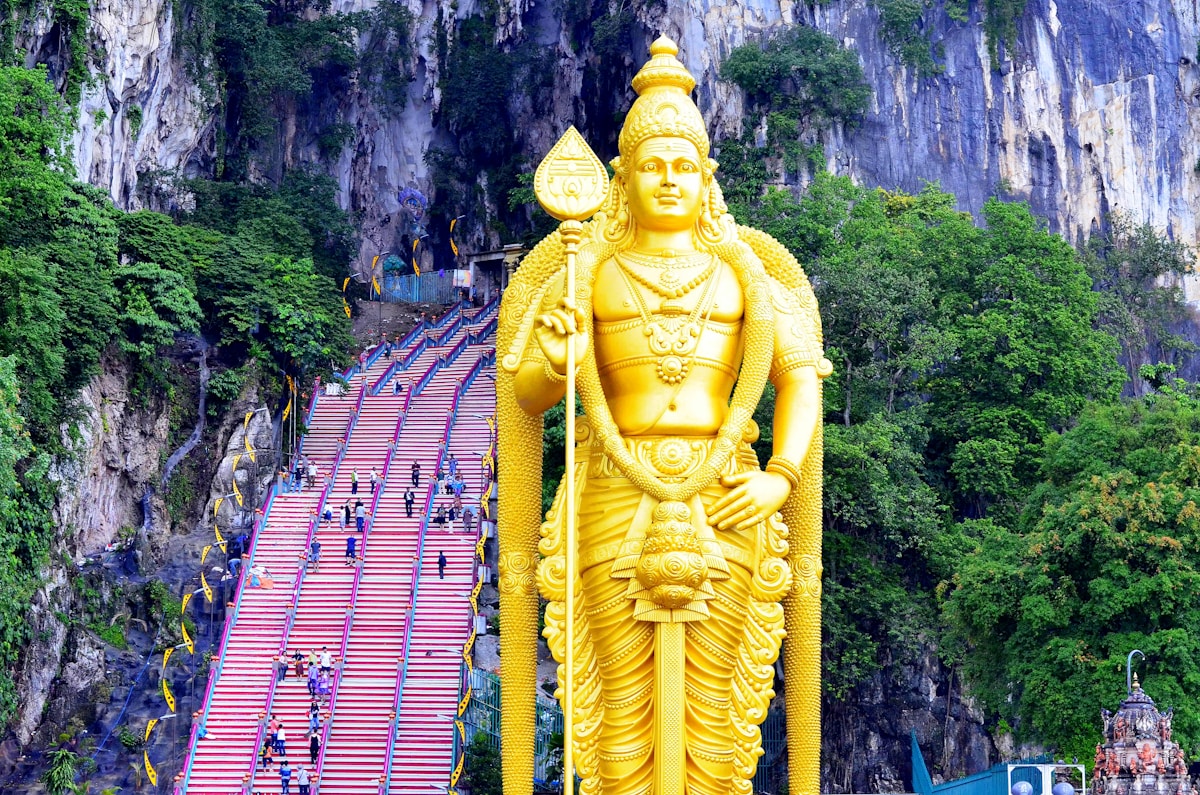
Kuala Lumpur rewards visitors who go beyond the obvious. The Petronas Towers are unmissable, but the city’s best experiences sit beside them: a brass-lantern-lit street food lane in Chinatown, 272 steps of Hindu pilgrims hauling milk pots up Batu Caves at dawn, and a glass-floored sky bridge 170 m above the city. Below, we cover the guided tours that make the most of KL’s range — from sunrise pilgrimages to late-night eating walks — with current prices and what to look for when booking.
Batu Caves Sunrise Tour
The standard approach to Batu Caves is fine. The sunrise approach is something else. You arrive before 6am, while the limestone cliff face is still deep grey and the sky behind it shifts from purple to gold. By the time daylight fills the cave, the main chamber is already warm with incense from the Sri Murugan shrines inside, and the macaques that guard the staircase are just waking up.
Most sunrise tours depart KL around 5am and return by 9am, making them compatible with a full day elsewhere. A good tour includes hotel pick-up, a local guide who can explain the temple’s history (the caves were formally consecrated as a Hindu shrine in 1891 after a Thaipusam festival), and sometimes a light Malaysian breakfast at a nearby hawker stall afterward.
Prices: expect to pay approximately RM 80–120 per person for a small-group sunrise tour with transport from central KL. Solo travellers can reach Batu Caves independently by KTM Komuter train (RM 3.50 each way, around 30 minutes from KL Sentral), but the 5am departure timing makes a tour worth the premium for most visitors.
The cave complex itself is free to enter. The Dark Cave — a separate 2 km gallery accessible by guided tour only — charges approximately RM 35 per adult and is worth adding if you have an hour to spare.
Kuala Lumpur Street Food Walking Tours
KL’s food scene is one of Southeast Asia’s best, and a guided street food walk is the most efficient way to navigate it. The city’s eating geography is divided: Petaling Street in Chinatown concentrates the best roast pork and wonton noodles; Jalan Alor in Bukit Bintang is the late-night hawker corridor known for grilled seafood and char kuey teow; and the covered markets of Chow Kit serve the northerly Malay and Indonesian food that tourists rarely find.
Evening walks (7pm–10pm) are more comfortable than midday ones: temperature drops, vendors are at full pace, and the atmosphere on Jalan Alor especially picks up once the sky goes dark. A good guide will steer you to the specific stalls they visit week after week rather than the tourist-facing ones at the entrance of each lane.
What to eat on a typical KL street food tour:
- Char kuey teow — flat rice noodles stir-fried at high heat with cockles, egg and Chinese sausage, best at Jalan Alor (from approximately RM 10 per plate)
- Nasi lemak — coconut rice with sambal, peanuts, cucumber and ikan bilis; Chinatown versions often include fried chicken
- Wonton noodle soup — Cantonese-style, sometimes served dry with chilli oil instead of broth
- Cendol — shaved ice with pandan jelly, red beans and coconut milk; the cleaner version of a dessert some tour guides rush past
Tours cost approximately RM 150–250 per person including all food tastings. Private food walks (2–4 people) cost more but cover more ground. Book a Kuala Lumpur food and activity tour through GetYourGuide to compare operators and read recent reviews.
Petronas Towers and KL Skyline Tours
The Petronas Twin Towers are the skyline, and any KL orientation tour will stop there. But the observation experience splits into two tiers: the Skybridge (Level 41–42, between the two towers, 170 m up) and the observation deck on Level 86 of Tower 2. Tickets include access to both, and the views from Level 86 — particularly at the golden hour before sunset — are among the best in Southeast Asia.
Timed entry tickets sell out on busy days. Standard city tours include queue-skip access, which is worth the premium on weekends. Skybridge tickets currently cost approximately RM 80 per adult for timed entry. The towers’ interior is best appreciated with a guide who can explain the Islamic geometric patterning in the facade (the eight-pointed star motif runs through the building from ground to pinnacle) and the engineering story of two separate contractors racing to complete each tower.
Beyond the towers, a well-designed KL city tour typically includes:
- Merdeka Square — the Padang where independence was declared in 1957, now flanked by the Sultan Abdul Samad Building in Moorish Revival style
- KL Tower (Menara KL) — an earlier observation point (421 m) that predates the Petronas Towers and offers a different perspective on the skyline
- Perdana Botanical Garden — 92 ha of city greenery, including the Butterfly Park and Bird Park (separate entry fees apply)
- Bukit Bintang — the shopping and dining district that makes a natural tour endpoint
Half-day city tours run approximately RM 100–180 per person excluding Petronas Tower entry. Full-day versions adding Batu Caves to the itinerary cost RM 180–280.
Day Trip to Genting Highlands
Genting Highlands sits 1,800 m above sea level in the Titiwangsa Mountains, about 50 km northeast of KL. The temperature up here is typically 15–25°C — a noticeable contrast to the 33°C city below — and the view back toward KL on clear days extends past the horizon.
The cable car (Skyway) ascends from Gohtong Jaya at the mountain base and is the preferred approach: 3.4 km of gondola over dense rainforest canopy, with the resort complex appearing from the cloud at the top. The cable car runs approximately every 15 minutes and costs RM 13–15 per person each way.
Genting’s main attractions are the casino — the only legal casino in Malaysia — and the outdoor/indoor theme parks under the Genting SkyWorlds brand. The theme park focuses on movie IP attractions (Lionsgate, 20th Century Studios) and requires a separate day pass. For visitors primarily interested in the cool air, the cable car and the summit views, a half-day is sufficient.
Group day trips from KL cost approximately RM 80–150 per person including transport and cable car. Driving independently from central KL takes around 45–60 minutes via the Karak Highway.
KL Batu Caves Day Trip (Standard)
Outside of the sunrise format, Batu Caves makes a solid half-morning visit from KL. The Hindu temple complex at the base of the cliff has been active since the 1890s, and the main attraction — the 100-year-old golden Lord Murugan statue at the staircase foot, standing 42.7 m — makes for a genuinely striking arrival photograph.
The 272 rainbow-painted steps up to the main cave are a moderate 10–15 minute climb. Inside the cathedral cave (also called Temple Cave), natural light falls through an open roof some 100 m overhead, illuminating the shrines in a way that makes the space feel larger than it is. Bring water; the climb gets warm even at 9am.
Day visit tours from KL typically add Batu Caves to a broader city itinerary — National Mosque, Chinatown, Little India — and run 5–6 hours. These suit visitors with limited time who want to see the city’s main layers in one go. For the caves specifically, the KTM Komuter train is comfortable and cheap if you are happy to visit independently.
Cultural and Heritage Tours: Chinatown and Little India
The oldest parts of KL — Petaling Street (Chinatown) and Brickfields (Little India) — deserve more than a rushed taxi stop. A walking heritage tour of Chinatown traces the late-19th-century Chinese immigrant settlements that built the city’s commercial core: the covered market stalls, the clan associations in their shophouses, the Sri Mahamariamman Hindu temple on Jalan Tun H.S. Lee that dates to 1873.
Brickfields, 2 km south, concentrates Tamil Indian culture: brightly painted Hindu temples, sari shops selling silk from Chennai and Coimbatore, and the scent of jasmine garlands sold by street vendors for temple offerings. The Sri Kandaswamy Kovil on Jalan Scott is the neighbourhood’s oldest place of worship and open to respectful visitors.
Heritage walking tours of these districts typically run 2–3 hours and cost approximately RM 80–140 per person. Smaller groups (4–8 people) allow more time at individual sites. These tours work well as morning activities before the afternoon heat builds.
Practical Tips for Booking KL Tours
When to book: At least 48–72 hours ahead for sunrise tours and anything including Petronas Towers queue-skip access. Last-minute same-day bookings are possible for street food walks and city driving tours on most dates.
Getting around: KL’s MRT and LRT network covers most tourist areas. Batu Caves is on the KTM Komuter line (Batu Caves station). Genting requires a car or tour bus. Taxis and Grab are reliable for short hops.
What to wear: Loose, breathable clothing for walking tours. Cover shoulders and knees for temple visits at Batu Caves and Brickfields — scarves are available to borrow at the cave entrance. Comfortable walking shoes are essential for the Batu Caves steps.
Best months: KL is walkable year-round. The wettest months are April and October–November, when afternoon downpours are common. Morning tours (start by 7–8am) avoid the worst of the heat and the rain typically holds off until early afternoon.
For a broader itinerary that fits these tours into a longer stay, see our 3-day Kuala Lumpur itinerary. If you are deciding between KL and another base, our where to stay in Kuala Lumpur guide covers the neighbourhoods worth choosing.