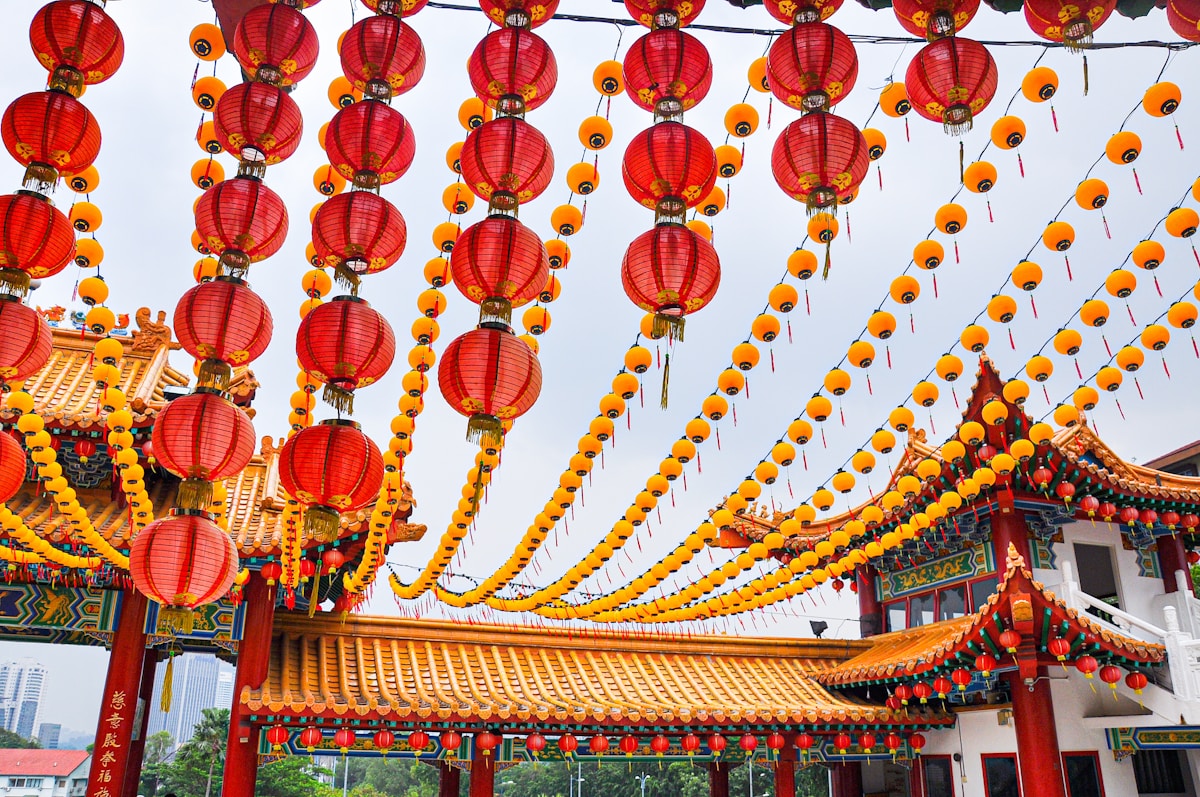
February is the final month of the northeast monsoon and the heart of Chinese New Year season - two facts that shape every aspect of travelling in Malaysia this month. The west coast remains in excellent condition, the east coast stays closed, and the festive calendar creates both opportunities and pricing surges.
Weather Across the Regions
Kuala Lumpur is warm (29–33°C) with occasional afternoon showers. February is slightly drier than January and one of KL’s most comfortable months. Humidity sits around 70–75%, lower than the October–December wet season.
Penang is outstanding in February. Georgetown enjoys warm, dry days and calm seas. February is one of the driest months on the island, making it ideal for heritage walking tours, street art exploration, and the full range of Penang’s hawker food scene.
Langkawi continues its peak dry season. The Andaman Sea is glassy calm, snorkelling at Pulau Payar Marine Park is at its best, and sunset cruises run without weather cancellations. This is Langkawi’s most expensive month - resort rates are at their annual peak.
East coast (Perhentian, Redang, Tioman): still closed. The northeast monsoon does not lift until March. Some Tioman resorts open in late February on a trial basis, but boat crossings remain unreliable. Do not count on east coast access in February.
Borneo sees its wettest period winding down. Kota Kinabalu is wetter than the west coast of Peninsular Malaysia but functional - mornings are often clear. Kuching and the Sarawak interior remain wet. Mount Kinabalu summit attempts are possible but cloud cover is more frequent than in the drier months (March–April, July–September).
Chinese New Year
Chinese New Year (CNY) is the defining event of February in Malaysia. Approximately 23% of Malaysia’s population is ethnic Chinese, and CNY is the country’s biggest commercial holiday.
Georgetown, Penang has the most authentic CNY celebrations in Malaysia. The Kek Lok Si Temple lights up with thousands of lanterns for a month-long display. Clan jetties host lion dance performances. Chap Goh Mei (the 15th day of CNY, sometimes called “Chinese Valentine’s Day”) sees women throwing mandarin oranges into the sea at the Esplanade - a matchmaking tradition unique to Penang.
Kuala Lumpur transforms with elaborate decorations at Pavilion, Mid Valley, and Suria KLCC. Thean Hou Temple in Robson Heights is the city’s most photogenic CNY location - tiered pagodas draped in red lanterns. Petaling Street in Chinatown is packed with festival shoppers.
Pricing impact: CNY week sees accommodation prices jump 30–50% across Penang, KL, Langkawi, and Ipoh. Domestic flights (especially KL–Penang, KL–Langkawi) sell out weeks ahead. Many Chinese-owned restaurants and shops close for 2–5 days during CNY - this includes some of Penang’s best hawker stalls. Malay and Indian restaurants remain open.
Thaipusam
If Thaipusam falls in February (it moves between January and February based on the Tamil calendar), the Batu Caves procession takes place. This is one of Malaysia’s most visually striking events - a million-strong crowd, kavadi bearers, and the 272-step climb to the temple cave. The golden Lord Murugan statue at the cave entrance is the world’s tallest.
Costs and Crowds
February is Malaysia’s most expensive month for domestic travel. CNY, Thaipusam (if it falls in February), and peak dry season on the west coast all converge. Book Penang and Langkawi accommodation 2–3 months ahead for CNY week. KL is slightly less pressured but still busy.
Outside CNY week, February offers excellent value - the festive decorations remain up for weeks after the holiday itself, and the crowds dissipate quickly once the official holiday ends.
What to Do in February
The Cameron Highlands are cool and pleasant - tea plantations, the Mossy Forest boardwalk, and Brinchang night market. Ipoh, halfway between KL and Penang, is an underrated February destination with its own Chinese heritage architecture, cave temples, and outstanding Cantonese and Hakka food.
Malacca (Melaka) is comfortable in February - the Jonker Street night market runs every Friday and Saturday, and the Baba Nyonya Heritage Museum is one of Malaysia’s best cultural experiences. The Peranakan (Straits Chinese) culture of Malacca has its own CNY traditions distinct from mainland Chinese customs.
The Bottom Line
February is festive, warm, and excellent on the west coast. If you time your visit to overlap with Chinese New Year, you will see Malaysia at its most celebratory - but book early and expect higher prices. The east coast remains off-limits until March.
Get a Malaysia eSIM, Compare travel insurance, or Browse tours and activities.
Plan Your February Trip
- Penang travel guide - Chinese New Year celebrations are outstanding in Georgetown, with lantern trails and street performances
- Malacca travel guide - Jonker Street night market, the Baba Nyonya Heritage Museum, and Peranakan CNY traditions
- Cameron Highlands travel guide - cool highland escape with tea plantations, mossy forest, and Brinchang night market
- Ipoh travel guide - underrated February destination with cave temples, colonial architecture, and white coffee
- Best time to visit Malaysia - full month-by-month breakdown and the best season for each region
Plan Your Trip
✈️ Book your flights to Malaysia 🛡️ Get travel insurance 📱 Stay connected with an eSIM 🚗 Rent a car 🏨 Search hotels in Malaysia on Booking.com