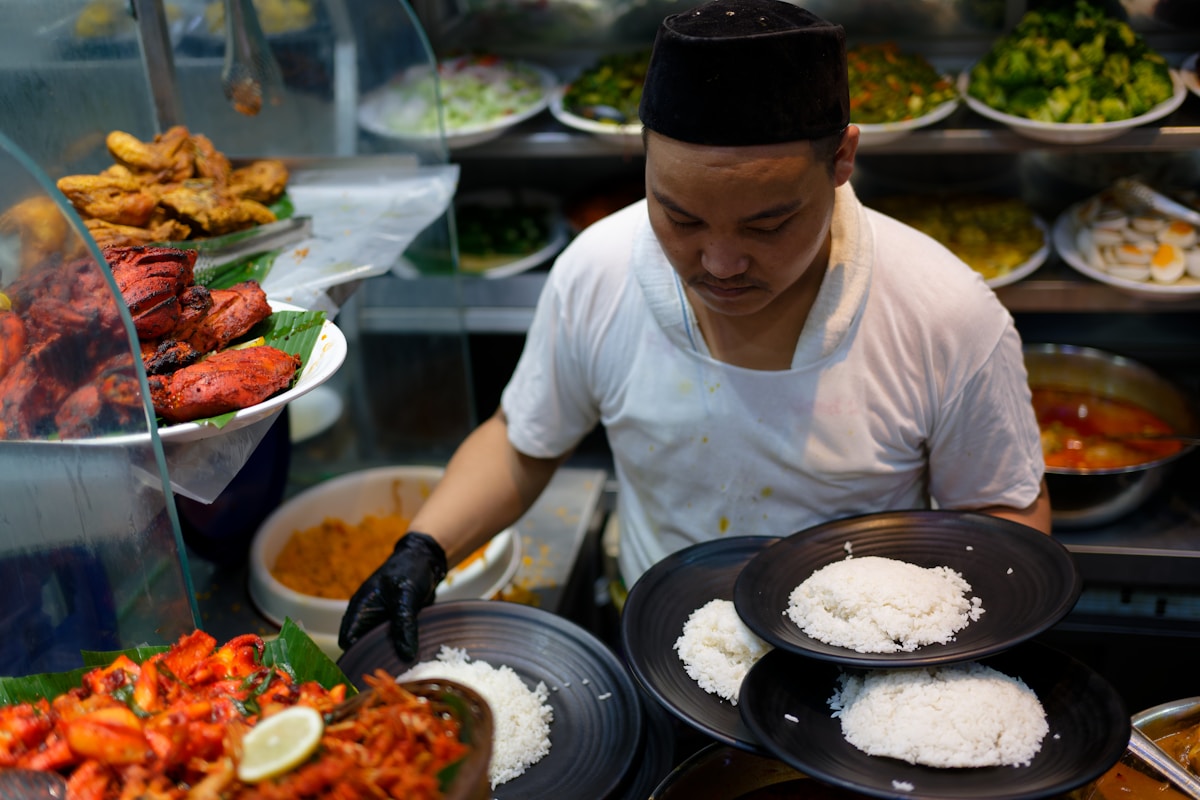
Penang holds a designation that few cities claim: UNESCO Creative City of Gastronomy. It’s the only city in Southeast Asia to hold it, and the title reflects something genuine. Georgetown’s food culture is the product of five centuries of Malay, Chinese (primarily Hokkien and Teochew), Indian (Tamil and Muslim Tamil), and Peranakan cooking intersecting in a port city - and the result is a density of excellent food per square kilometre that is genuinely hard to match anywhere in the region.
This guide covers the essential dishes, the named stalls worth going out of your way for, the best hawker areas, and how to navigate Georgetown’s food scene.
Penang’s Signature Dishes
Penang Assam Laksa
The single dish most associated with Penang. A sour, pungent fish soup made with a tamarind-based broth (not coconut milk - that’s curry laksa), flaked mackerel, thick rice noodles, cucumber, onion, torch ginger flower (bunga kantan), fresh chilli, and a spoonful of shrimp paste (belacan) stirred in at the table. The flavour is sharp, sour, and intensely savoury.
Where to eat it: The stall inside Ayer Itam Market (Pasar Ayer Itam) near the Kek Lok Si temple base is the most consistently recommended in Penang - operating for several decades, typically from around 11am until it sells out (often by 2pm). Queue time is real. A bowl costs approximately MYR 5–7 as of 2026.
Char Kway Teow
Penang’s version uses pork lard rather than vegetable oil, giving it a richer, smokier character than KL interpretations. The wok heat must be high - the char on the noodles is the point, not an accident. Cockles (siham) are standard in the Penang version; prawns and Chinese sausage are usual additions. Not halal.
Where to eat it: Sister’s Char Kway Teow (Jalan Kelawei, Georgetown) is one of the most referenced stalls in the city - run by two sisters, open from approximately 11am, closed when sold out. Expect a queue. A plate is approximately MYR 8–12 as of 2026.
Lorong Selamat in Georgetown has a cluster of char kway teow stalls operating from late afternoon; this is where locals eat rather than tourists.
Penang Hokkien Mee (Prawn Mee)
Yellow noodles and rice vermicelli in a rich, cloudy prawn broth made by simmering prawn shells and pork bones for hours. Topped with prawns, hard-boiled egg, water kangkong (morning glory), bean sprouts, and a small amount of sambal. The broth is the defining element - it should be deeply savoury and slightly sweet from the prawn carapace.
Not to be confused with KL’s version of hokkien mee (which is the stir-fried dark soy sauce noodle dish). In Penang, “hokkien mee” always means this prawn soup.
Where to eat it: Restoran Sin Hwa on Jalan Penang (near Penang Road) has been operating for over 40 years. Open from approximately 8am, closed by 1–2pm. Approximately MYR 7–12 per bowl as of 2026.
Nasi Kandar
A Penang institution of Indian Muslim origin. Plain rice or biryani served cafeteria-style with a variety of curries ladled over - chicken curry, fish roe curry, prawn sambal, mutton curry, and dhal are common. The key is the “banjir” pour: the stall server pours a mix of all available curry gravies over the rice, the excess forming a pool. You pay by the dish selected, not a set price. Halal.
Where to eat it: Line Clear Nasi Kandar (Penang Road, also known as Line Clear Restaurant) is the most-cited nasi kandar stall in Penang - operating since the 1930s from a converted alley, open 24 hours. Breakfast hours (6–10am) are less crowded than lunch. Budget approximately MYR 12–20 for a full plate with two or three curries as of 2026.
Hameediyah Restaurant (Campbell Street) is older still - established 1907 - and is the place for murtabak as well as nasi kandar.
Pasembur (Indian Rojak)
A Penang-specific salad of mixed fried items - prawn fritters, boiled egg, cucumber, turnip, tofu, and bean sprouts - tossed in a thick, sweet-spicy peanut and sweet potato sauce. Available at Tamil Muslim stalls across Georgetown, often alongside roti canai and murtabak. MYR 6–10 per serving as of 2026. Halal.
Where to eat it: The stalls along Jalan Macalister and at Gurney Drive Hawker Centre are reliable.
Cendol
Georgetown has two frequently cited cendol stalls on Jalan Penang, operating side by side - Teochew Chendul (the better-known of the two) has been there for decades. The version uses fresh-ground pandan jelly, fresh coconut milk, and dark Gula Melaka from Melaka. A bowl is MYR 3.50–5.00 as of 2026. Arrive before 1pm - both stalls often sell out by early afternoon.
Named Stalls Worth Going to Directly
Tek Sen Restaurant (Carnarvon Street, Georgetown): A Hokkien-Cantonese kitchen specialising in slow-braised pork knuckle, clay pot dishes, and stir-fried vegetables. One of the most-respected restaurants in Georgetown. Book ahead - it fills up fast for dinner. Budget approximately MYR 40–60 per person as of 2026.
Joo Hooi Café (Penang Road, Georgetown): An air-conditioned coffee shop with its own in-house stalls. One of the better spots for a range of Penang dishes under one roof: assam laksa, wonton soup, curry mee. Good for a first-day overview. Dishes approximately MYR 6–12 as of 2026.
Auntie Gaik Lean’s Old School Eatery (Penang Road): Nyonya home cooking - ayam pongteh (braised chicken with potatoes and fermented soybean), braised pork with black fungus, and Nyonya kuih for dessert. Small restaurant, seating limited - arrive before 12pm for lunch or call ahead. Approximately MYR 15–25 per person as of 2026. (See also: Nyonya cuisine guide.)
Sup Hameed (Jalan Penang): Late-night bone soup (sup tulang) and murtabak. One of the few places in Georgetown operating after midnight. Halal.
Georgetown Hawker Trail
A logical route to cover the core hawker areas on foot:
Morning (7–10am): Start at Jalan Hutton mamak stalls for roti canai and teh tarik - MYR 3–5. Walk east to Campbell Street for Hameediyah murtabak if you want a second round. Continue to Penang Road for Joo Hooi Café’s morning noodles.
Lunch (11am–2pm): Head to Lorong Selamat for char kway teow. Then Jalan Penang for Teochew Chendul cendol. If you want assam laksa, this is the time to make the 15-minute grab-car ride to Ayer Itam Market.
Late afternoon–evening: Return to Georgetown for the Chulia Street hawker stalls (operating from 5pm) - these have a wider mix of stalls and are less expensive than Gurney Drive.
Gurney Drive vs New Lane vs Chulia Street
Gurney Drive Hawker Centre (Persiaran Gurney): The largest and most visited hawker centre in Penang, with roughly 100 stalls along the seafront. Convenient, with a strong range of dishes. Prices are moderate: MYR 6–15 per dish as of 2026. The setting is pleasant - outdoor tables with sea views. Downside: some stalls have become tourist-oriented and the quality is uneven. Best for an overview of Penang food; not always the best individual dishes.
New Lane (Lorong Baru): Georgetown locals consistently rate New Lane above Gurney Drive for food quality. Open from approximately 5–6pm. Char kway teow, prawn mee, fried oyster omelette, and chicken wings are the standout items. Less formal seating - plastic chairs on the street - and significantly fewer tourists. Prices similar to Gurney Drive.
Chulia Street (Jalan Chulia): The area around Chulia Street in the UNESCO heritage zone has a concentration of hawker stalls operating from late afternoon. More convenient for tourists staying in Georgetown. The stalls at the street’s western end tend to be better quality than those closest to the backpacker guesthouses. Particularly good for late-night eating (many stalls run until midnight).
The verdict: For quality, New Lane wins. For convenience and atmosphere, Gurney Drive. For location within the heritage zone, Chulia Street.
When to Eat
Penang hawker culture runs on unusual hours. Many of the best stalls are open only for breakfast and lunch, closing by 1–2pm. If you arrive in the afternoon expecting to eat your way through the famous stalls, you’ll find most closed.
Early risers (6–9am): Roti canai at mamak stalls, morning char kway teow at Lorong Selamat, wonton noodles at coffee shops.
Mid-morning (9am–noon): Hokkien mee (prawn mee) - most stalls open around 8–9am and sell out by noon. Nasi kandar breakfast at Line Clear.
Lunch peak (noon–2pm): Assam laksa at Ayer Itam Market, cendol on Jalan Penang. Arrive by 11:30am for the cendol stalls.
Evening and night (6pm–midnight): Gurney Drive and New Lane hawker centres, Chulia Street stalls. Char kway teow stalls tend to have the longest hours of any stall type.
Take a Guided Food Tour of Penang
Penang’s reputation as Malaysia’s food capital is built on a density of hawker stalls that rewards insider knowledge — the stall producing the definitive char kway teow may be a weathered cart on a side street with no signage, open only from 3pm until it sells out. A guided food tour through George Town brings a local guide who knows the operational hours, the queue dynamics, and which version of assam laksa in the city is worth choosing over a more accessible alternative. Evening tours typically run three to four hours, cover 8–10 tastings, and include both the famous spots on Gurney Drive and the less-visited stalls on Chulia Street and in the heritage zone.
Book a guided food tour of Penang.
Getting to Penang
Georgetown is the food-eating base. Fly into Penang International Airport (PEN) - a 30-minute taxi or Grab car ride to Georgetown costs approximately MYR 25–40 as of 2026. Georgetown is walkable for most hawker destinations within the heritage zone; a grab car is needed for Ayer Itam Market and Gurney Drive.
Cross-link: Malaysian street food guide | Penang things to do | Best hotels in Penang