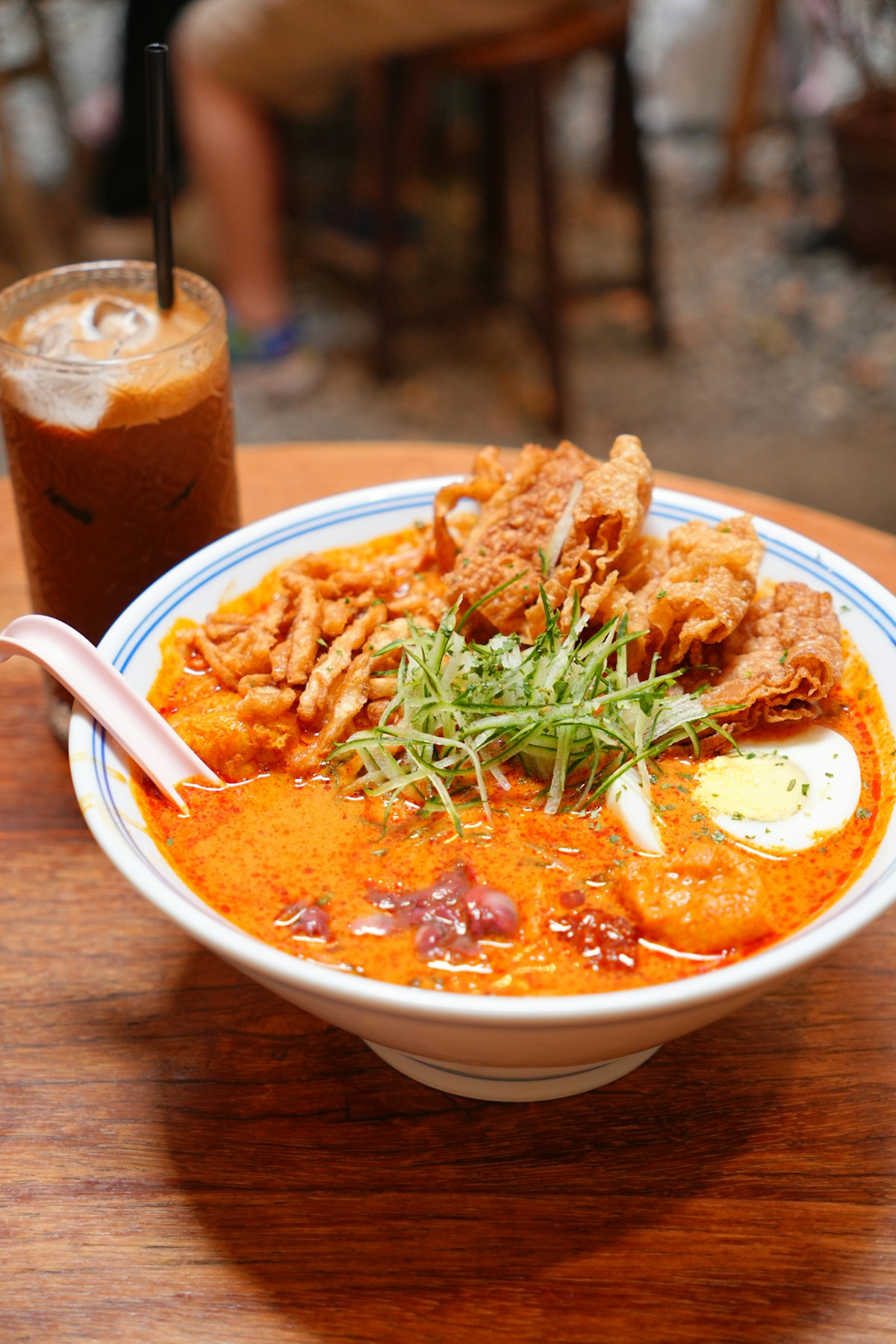
Nyonya cuisine is the cooking tradition of the Peranakan people - the descendants of Chinese immigrants who settled along the Strait of Malacca from the 15th century onwards and married into local Malay communities. The culture they developed, known as Baba-Nyonya (Baba for the men, Nyonya for the women), produced a hybrid culinary tradition that draws from southern Chinese cooking techniques while using the spices, aromatics, and ingredients of the Malay peninsula: lemongrass, galangal, belacan (fermented shrimp paste), candlenuts, turmeric, and pandan.
The result is food that belongs fully to neither Chinese nor Malay cooking. It is more complex than either - labour-intensive to prepare, richly spiced, and built on rempah (spice pastes) that are traditionally ground by hand on a batu lesong (stone mortar). Understanding Nyonya cooking means understanding the culture that produced it.
The History of Baba-Nyonya Culture
The Peranakan community formed when Chinese merchants, primarily Hokkien-speaking, settled in the port towns of Malacca, Penang (then Penang Hill/Prince of Wales Island), and Singapore from the 1400s onwards. These early settlers - predominantly men - married local Malay women and developed a creolised culture: speaking a distinctive patois mixing Malay and Hokkien (Baba Malay), wearing hybrid dress (the sarong kebaya for women), and cooking food that fused Chinese ingredients with Malay methods.
The most established Peranakan communities are in Melaka (the oldest), Penang, and Singapore. Each city’s Nyonya cooking has evolved separately - Melaka’s version tends to be sweeter and darker (using more palm sugar and fermented black beans), Penang’s is spicier and more tart.
During the colonial era, Peranakans often served as intermediaries between British administrators and the local Malay population, and many accumulated significant wealth. The elaborate terraced townhouses they built - decorated with Delft tiles, carved wooden screens, and Chinese porcelain - survive in the heritage zones of both Melaka and Georgetown. These buildings are the physical context in which Nyonya food was developed.
Key Dishes
Ayam Pongteh
Braised chicken with potatoes in a sauce of fermented soybean paste (tauchu), palm sugar, and garlic. The flavour is earthy, slightly sweet, and deeply savoury. This is a foundational Nyonya dish - comfort food in the fullest sense. The tauchu gives it a fermented depth that distinguishes it from any Chinese braised chicken dish. Typically served with white rice or on its own as part of a multi-dish meal. Approximately MYR 15–22 per portion at Nyonya restaurants as of 2026.
Pie Tee
Small, crispy pastry cups filled with a sautéed mixture of turnip (bangkuang), carrot, shrimp, and sometimes crab meat, garnished with a strip of chilli and a dot of sweet sauce. A Nyonya appetiser - intricate to make (the pastry cups are deep-fried individually on a special mould), and historically a marker of a cook’s skill. Usually served 3–6 pieces per order. Approximately MYR 8–15 for a portion as of 2026.
Otak-Otak
Spiced fish paste blended with coconut milk, lemongrass, galangal, turmeric, kaffir lime leaves, and chilli, wrapped in banana or coconut leaves and grilled over charcoal. The Melaka version is a dense, firm cake; the Muar (Johor) version is softer and richer. Both are fragrant from the banana leaf and slightly smoky from the grill. Sold at hawker stalls as a snack - MYR 2–3 per piece. Otak-otak in Muar, about 100km south of KL, is considered the benchmark; Georgetown also has good versions.
Babi Pongteh
The pork version of ayam pongteh - pork belly braised in the same tauchu and palm sugar sauce, with potatoes absorbing the cooking liquid. This is the richer, more celebratory version of the dish, and it is not halal. The fat in the pork belly softens during the long braise and carries the flavour of the sauce into each layer.
Assam Pedas
A tart, spicy fish curry made with tamarind (assam), dried chillies, ginger flower, and laksa leaf (kesum). The broth is sharp and sour - the tamarind provides significant acidity. Traditionally made with stingray (ikan pari) or pomfret, though other firm fish work. This dish demonstrates the Malay influence in Nyonya cooking: the method and spice base are Malay; the addition of galangal and the careful balancing of sweet and sour reflect the Chinese culinary sensibility.
Nyonya Laksa
Melaka’s Nyonya laksa is a coconut-milk-based curry soup - thick, rich, and less sour than Penang’s assam laksa. Typically served with rice noodles or spaghetti-thin laksa noodles, prawns, tofu puffs, bean sprouts, and a hard-boiled egg. The rempah (spice paste) is the base and requires lemongrass, dried shrimp, candlenuts, galangal, and belacan ground together. Approximately MYR 8–14 per bowl at hawker stalls as of 2026.
Nyonya Kuih
Kuih (or kueh) are small cakes and confections that function as Nyonya afternoon snacks and desserts. They are made from rice flour, glutinous rice flour, coconut milk, pandan, and palm sugar in various combinations, steamed or baked in banana leaf moulds. Making kuih is a traditional skill passed between generations of Nyonya women.
Common varieties:
Kuih dadar (pandan crepes): Thin pandan-green crepes rolled around a filling of grated coconut cooked in palm sugar. Sweet, fragrant, and slightly chewy.
Ondeh-ondeh: Small glutinous rice balls rolled in toasted coconut, with a liquid palm sugar centre that bursts when bitten. One of the most distinctive kuih.
Kuih bengka (baked tapioca cake): Dense, slightly chewy cake of grated tapioca, coconut milk, and pandan, baked until the surface is golden. Melaka’s version is particularly well-regarded.
Ang ku kueh: Red glutinous rice skin cakes shaped in a tortoise mould (the tortoise symbolises longevity), with a filling of mung bean paste or peanut paste. A Chinese-origin kuih that has become fully integrated into Nyonya cooking.
Kuih talam: A two-layer steamed cake - green pandan-flavoured rice flour base, white coconut milk and tapioca flour top layer. The contrast of slightly salty coconut and sweet pandan is the defining characteristic.
Kuih shops are common in Melaka, Penang, and KL Chinatown, operating from early morning and often selling out by noon.
Where to Eat Nyonya Food
Melaka
Melaka is the original heartland of Peranakan culture. The best Nyonya cooking in Malaysia is concentrated here.
Nancy’s Kitchen (Jalan KL 3/8, Melaka): One of the most consistently recommended Nyonya restaurants in Melaka - family-run, with a menu covering the full range of Nyonya dishes: ayam pongteh, pie tee, assam pedas, inchi kabin (Nyonya fried chicken), and otak-otak. Budget approximately MYR 25–40 per person as of 2026. Open for lunch from 11am; closed on Tuesdays.
Baba Charlie Nyonya Cake & Cafe (Jalan Tun Tan Cheng Lock, Melaka): The most-cited kuih specialist in Melaka - traditional Nyonya kuih made daily, sold by piece or by tray. The kuih dadar and ondeh-ondeh are particularly good. Open from approximately 8am; sells out early on weekends.
Pak Putra Restaurant (Jalan Temenggong, Melaka): Primarily a tandoori and naan restaurant but also serves some Peranakan-influenced dishes, useful for context on the Indian-Muslim thread in Melaka’s food culture. Open evenings only.
Penang
Penang’s Nyonya cooking evolved separately from Melaka’s and tends to be spicier and more tart.
Auntie Gaik Lean’s Old School Eatery (36 Penang Road, Georgetown): The best-regarded Nyonya restaurant in Georgetown. The menu is home-style - ayam pongteh, braised pork with black fungus, inchi kabin, and fried bee hoon (rice vermicelli). Small restaurant, fills up fast. Budget approximately MYR 20–35 per person as of 2026. Open for lunch only, closed Sundays.
Perut Rumah (Jalan Masjid Kapitan Keling, Georgetown): A more casual Nyonya spot in the heritage zone, open for both lunch and dinner. Useful if Auntie Gaik Lean’s is full.
Kuala Lumpur
Limapulo (Jalan Doraisamy, KL): The most-referenced Nyonya restaurant in KL - the name means “50” in Malay (as in 50 Dressing Lane, which was the address of a traditional Nyonya home). Serves Melaka-style Nyonya food: buah keluak (black nut curry - an Indonesian-Peranakan dish), ayam pongteh, and otak-otak. Approximately MYR 35–55 per person as of 2026. Open for lunch and dinner, closed Mondays.
Precious Old China (Central Market, KL): Atmospheric restaurant in the Annexe Gallery of KL’s Central Market building. Serves Nyonya and Peranakan-influenced dishes in a setting with antique furniture and Peranakan tiles. Slightly more tourist-oriented than Limapulo but covers the full range of Nyonya dishes. Approximately MYR 30–50 per person as of 2026.
Cooking Nyonya Food: What Makes It Distinctive
Several techniques and ingredients are specific to Nyonya cooking and help explain its character:
Rempah (spice paste): The foundation of most Nyonya curries and stews. Made by grinding dried chillies, shallots, garlic, galangal, lemongrass, candlenuts, turmeric, and belacan together - traditionally on a flat stone, now by blender. The paste is fried in oil before liquids are added, which caramelises the aromatics and builds the base flavour. The quality of the rempah determines the quality of the dish.
Belacan (fermented shrimp paste): Used in almost every savoury Nyonya dish, either in the rempah or as a condiment. It has a strong, ammonia-like smell when raw that transforms to a deeply umami, almost nutty flavour when cooked. It’s the signature depth-note in Nyonya cooking.
Pandan (screwpine leaves): Provides the distinctive green colour and vanilla-adjacent floral fragrance used across Nyonya kuih and desserts. Pandan leaf extract is used as the colouring agent in kuih dadar and many other cakes.
Bunga kantan (torch ginger flower): The bud of a pink ginger lily, sliced thinly and used in assam laksa, otak-otak, and salads. Provides a subtle floral bitterness that is difficult to replicate with any substitute.
Visiting Peranakan Heritage Sites
The food and the culture are inseparable. Visiting Melaka’s Baba Nyonya Heritage Museum (Jalan Tun Tan Cheng Lock) gives essential context - three connected townhouses filled with Peranakan furniture, porcelain, wedding costumes, and kitchen equipment. Entry approximately MYR 16 as of 2026; open 10am–5pm, closed Tuesdays.
In Penang, the Pinang Peranakan Mansion (Armenian Street, Georgetown) has a comparable collection. Entry approximately MYR 25 as of 2026; open daily.
Take a Guided Nyonya Food Tour
Nyonya cuisine is deeply embedded in the heritage neighbourhoods of Penang and Malacca, where the same families have been grinding the same rempah pastes for generations — context that turns a meal into a cultural experience. Guided Nyonya food tours in Georgetown typically run through the shophouse streets of the Peranakan quarter, stopping at old kopitiam breakfast stalls, Nyonya kuih vendors, and restaurants where the menu is designed for residents, not visitors. In Malacca, tours often include the Portuguese settlement on weekend evenings where Devil’s Curry and caldereta are served at communal tables near the water.
Book a guided Nyonya food tour.
Related Guides
- Penang food guide - Georgetown’s food scene including Nyonya restaurants, assam laksa, and Gurney Drive
- Malaysian street food guide - the broader hawker culture context: nasi lemak, roti canai, char kway teow
- Malacca travel guide - the heartland of Peranakan culture and the home of the Baba Nyonya heritage
- Malacca heritage walking tour - Dutch Square, Christ Church, St Paul’s Hill, and the Peranakan quarter
- Peranakan Nyonya culture guide - the history and cultural context of the Straits Chinese community in Malaysia