Penang’s attractions are split between the heritage city of Georgetown and the wider island. Georgetown is dense with things worth seeing within a small walkable area; the island beyond it requires transport but rewards the effort. Below is a practical rundown of the main draws, with entry prices and logistics where relevant.
Georgetown Street Art
The street art programme commissioned by the Penang state government from 2012 onward transformed Georgetown into one of the most photographed cities in Southeast Asia. The murals are painted directly onto shophouse walls and are free to see.
The most famous is “Children on a Bicycle” by Lithuanian artist Ernest Zacharevic on Lorong Stewart - two children on a real bicycle attached to the wall, painted as if riding. Others by Zacharevic include “Little Children on a Chair” (Lorong Armenian), “Boy on a Bike”, and “Brother and Sister on a Swing”. A printed or downloaded street art map (available at most Georgetown guesthouses or online via the George Town World Heritage office) helps connect the locations efficiently. Allow 2–3 hours for a focused street art walk around the heritage zone.
The murals are permanent and maintained; the wrought-iron caricature sculptures (another layer of the same programme) are on plaques throughout the same area and depict scenes from Georgetown’s history.
Cheong Fatt Tze Mansion (Blue Mansion)
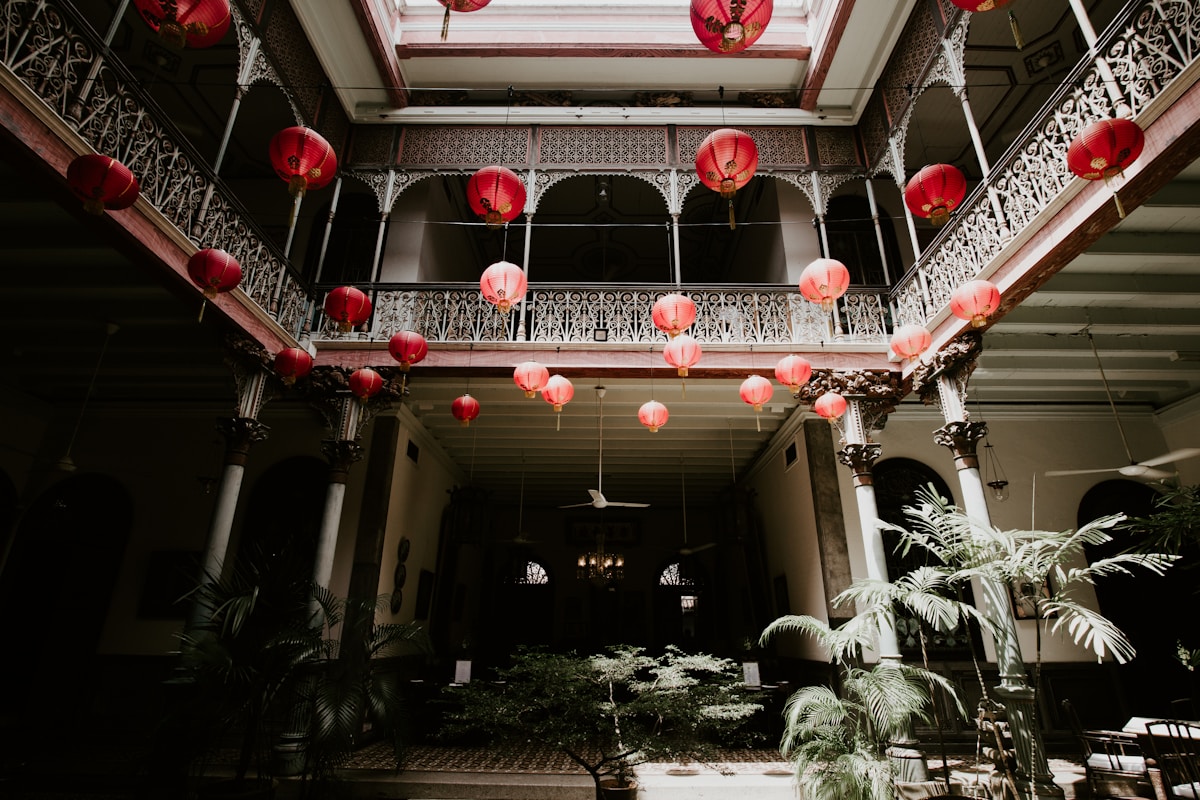
The Blue Mansion on Leith Street is a 1880s indigo-painted Chinese courtyard mansion commissioned by Cheong Fatt Tze - a Hakka merchant who built one of the largest business empires in Southeast Asia. The building is one of the most architecturally complete examples of southern Chinese townhouse architecture outside China, with internal courtyards, Feng Shui-compliant room layout, and hand-painted ceramic tiles imported from Europe.
Entry costs RM25 for adults (guided tour included - the house is not open for self-guided exploration). Tours run at 11am and 2pm daily, last approximately 50 minutes, and are worth taking even if you are not interested in architecture, because the guide contextualises the history of Penang’s Chinese merchant class effectively. For a broader heritage experience, a guided Georgetown walking tour covers the Blue Mansion alongside street art, clan jetties, and hidden temples in a single half-day.
The mansion also operates as a boutique hotel (16 rooms, RM450–900 per night) - staying here is a distinctive Penang experience if budget allows.
Kek Lok Si Temple
Kek Lok Si is the largest Buddhist temple in Malaysia, built on a hillside in the Air Itam neighbourhood 6 km from Georgetown. The complex includes the Ban Po Thar pagoda (seven tiers, 30 metres tall), a large compound of prayer halls and shrines, and a 30-metre bronze statue of Kuan Yin at the top accessible by cable car.
Entry to the main temple complex is free. The cable car to the Kuan Yin pavilion costs RM8 one way, RM12 return. The complex gets crowded from 10am onward - arriving at 8–9am gives a quieter experience and better light for photography. Allow 1.5–2 hours.
Getting there: Grab from Georgetown runs RM10–14 and takes 20–25 minutes. The Rapid Penang bus 201 and 204 also serve the area but are slower.
Clan Jetties
The Clan Jetties are a series of wooden stilt villages on the Georgetown waterfront, built in the 19th century by Chinese immigrant clans - Chew, Tan, Lee, Koay, Mixed Clan, and Lim. Each jetty was settled by members of the same clan, who built their homes on piles over the sea and maintained their own clan temple at the jetty entrance.
Chew Jetty is the largest and most accessible - the walkway extends several hundred metres into the strait, with homes, a community temple, and souvenir stalls on either side. Around 200 families still live here. Entry is free. The best time to visit is early morning or early evening when light is low and the jetty is less crowded with tour groups.
Pinang Peranakan Mansion
This mansion on Church Street contains one of the largest collections of Baba Nyonya (Peranakan Chinese) artefacts in Malaysia - furniture, ceramics, silverware, textiles, and photographs from the Straits Chinese community’s peak in the late 19th and early 20th centuries. Entry is RM30. The building itself is a green-painted courtyard house, smaller than the Blue Mansion but with an extremely dense collection. Allow 1–1.5 hours.
Penang Hill (Bukit Bendera)
At 830 metres, Penang Hill is the island’s highest point and the only place where you genuinely escape the lowland heat - temperatures at the summit are 5–8°C cooler than Georgetown. The funicular railway from the base station takes 5 minutes and runs continuously throughout the day. Adult return tickets are RM30 (check the official Penang Hill website for current pricing, which changes periodically).
At the summit: views across Georgetown and the Malacca Strait on clear days, the Owl Museum, David Brown’s restaurant (colonial bungalow setting, higher prices, worthwhile for the location), and a small Hindu temple and mosque within close proximity of each other. The mossy forest trail at the top (David Brown’s area) is a 20-minute walk through cloud forest. Arrive before 9am for the clearest views - haze and cloud build through the morning.
Getting to the base station: Rapid Penang bus 204 from Georgetown (Weld Quay), or Grab (RM15–22).
Khoo Kongsi
The Khoo Kongsi on Cannon Square is the most elaborately decorated Chinese clan temple in Malaysia. Built by the Khoo clan in 1906 (replacing an earlier structure that burned down), the temple’s facade is decorated with detailed Cantonese-style carved stonework, ceramic figurines, and painted beams. Entry is RM10. It takes about 30 minutes to see properly.
Fort Cornwallis
Fort Cornwallis on the esplanade is the site where Captain Francis Light of the East India Company landed in 1786, establishing the British presence in Penang. The star-shaped fort structure dates from an 1804 rebuild in brick. Inside: old cannons, including the famous Seri Rambai cannon associated with fertility rituals, a small amphitheatre, and interpretive panels on Georgetown’s colonial history. Entry is RM20.
Comparing Guided Tour Options in Penang
Penang’s guided tour market divides naturally into three categories: heritage walking tours, food tours, and island excursions. Heritage walking tours of the Georgetown UNESCO zone are the most common — a well-structured 3-hour walk covers the Cheong Fatt Tze Mansion, Clan Jetties, Khoo Kongsi, and the principal street art murals with historical context that would take a self-guided visitor half a day of research to replicate. Prices run RM80–150 per person for group walks; private guide rates for a similar itinerary are RM250–400 for up to four people. The difference is primarily pacing — private tours can linger longer at the Blue Mansion and skip the clan jetty crowd peak. Penang tours on GetYourGuide list both formats.
Food tours are the other major draw and Penang earns that reputation. Evening hawker tours through Gurney Drive and the Kimberley Street area run 3–4 hours and cost RM120–180 per person, typically covering eight to ten tastings — char kway teow, Penang laksa, cendol, nasi kandar — at stalls the guide has pre-vetted. A good food tour in Penang is meaningfully different from wandering independently: stall quality varies considerably and the best spots are not always the most visible ones. Morning food tours that start at kopitiam coffee shops and work through to the hawker stall lunch circuit are an alternative format that some operators run at RM90–130 per person.
Island excursions — Penang Hill with guide, Kek Lok Si extended visit, or a half-day cycling tour of the Malay kampung areas outside Georgetown — are less common but available as private bookings. For visitors who want to see both Georgetown’s heritage and the island’s rural character in a single day, a full-day guided format at RM350–500 covers more ground than either a standalone walking tour or food tour. Compare options and read current operator reviews at Penang tours before deciding which format fits your schedule.
For day trips from Georgetown to Ipoh, Taiping, or Langkawi, the Penang day trips guide covers logistics. For accommodation, browse hotels in Penang on Booking.com.