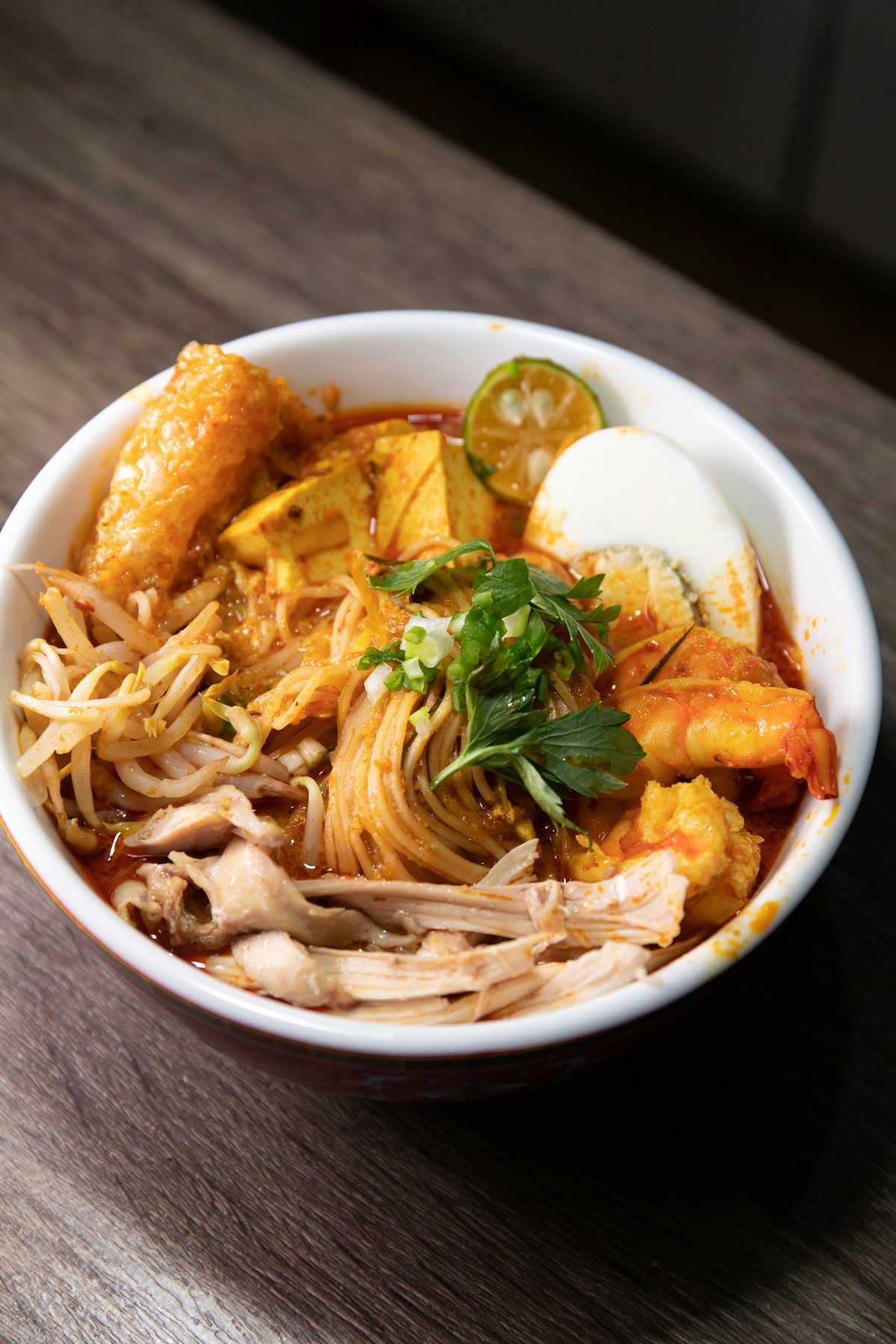
Ipoh has a food reputation that exceeds its size - a city of around 750,000 that generates a volume of culinary pilgrimage disproportionate to its population. The Chinese community here is predominantly Cantonese and Hakka, and the local dishes reflect both heritages: delicate noodle soups, fresh tofu and bean products, slow-cooked braises, and a dim sum tradition that is serious by any standard. The soft water from the limestone aquifer under the Kinta Valley is credited locally for the quality of the tofu, bean sprout, and noodle preparations - an attribution that is hard to verify but is widely repeated.
Ipoh White Coffee
White coffee (kopi putih) is Ipoh’s most exported food claim. The preparation uses robusta beans roasted with palm oil margarine (rather than the sugar and wheat used in conventional kopi roasting), which produces a lighter-coloured, less bitter brew. It is served with condensed milk, hot or iced.
The style was developed in the early twentieth century coffee shops of the Old Town, and the Oldtown White Coffee national chain takes its name and origin from here - though the chain version is a mass-produced approximation of the original. For the genuine article, the traditional kopitiam on Jalan Bandar Timah are the standard references.
Sin Yoon Loong (51 Jalan Bandar Timah) has been open since 1937 and is the most cited traditional coffee shop in Ipoh. The coffee is prepared to order, poured from a height over condensed milk in the Hainanese style, and served with kaya (coconut jam) toast and half-boiled eggs. Arrive before 9am; by 10am on weekends the queue extends out the door and the kitchen is frequently sold out of kaya toast.
Thean Chun (73 Jalan Bandar Timah, a few doors from Sin Yoon Loong) operates on the same model and is sometimes quieter - a practical alternative if Sin Yoon Loong is at capacity.
Bean Sprout Chicken (Taugeh Ayam)
This is Ipoh’s signature dish: poached free-range chicken, blanched local bean sprouts (tauge), a bowl of rice or noodles, and a dark soy dipping sauce with chilli and ginger. The preparation sounds simple - it is - but the quality of the components matters. Ipoh’s bean sprouts are fatter and crunchier than varieties grown elsewhere; the chicken is poached until just cooked and served at room temperature. The combination is light and clean.
Lou Wong (49 Jalan Yau Tet Shin) and Onn Kee (Jalan Yau Tet Shin, a few doors down) are the two most established restaurants for this dish and have a longstanding friendly rivalry. Both operate a similar model: arrive, order by pointing at the portions hanging in the window (half chicken, quarter, or mixed cuts), add a portion of bean sprouts and a bowl of rice or noodles, and add condiments. Meal for one: RM15–25. Lunch and dinner; popular enough that a short queue at peak hours is normal.
Dim Sum
The Cantonese heritage in Ipoh produces a dim sum culture that local residents take seriously. Dim sum restaurants in Ipoh open early - from around 6am - and operate on the traditional trolley or order-card system. The standard preparations (har gau, siu mai, char siu bao, cheung fun, lo mai gai) are well-executed; the egg tarts (dan tat) deserve their own mention below.
Several Old Town dim sum restaurants are concentrated near the Jalan Yang Kalsom and Jalan Bijeh Timah area. The scene is most active on weekend mornings when families from across the Kinta Valley converge for yum cha. Budget RM20–35 per person for a full dim sum breakfast.
Hor Heen (Flat Rice Noodles in Clear Soup)
Hor heen is a style of flat, silky rice noodle (similar to kway teow but cut wider and softer) served in a clear, light chicken or pork broth. The Ipoh version is specifically associated with prawn-based broth variants - the soup is clarified and delicately flavoured, with the noodles as the centrepiece rather than a base for heavy toppings.
Look for this dish at wet market stalls near the Pasar Ipoh (Ipoh Market) in the morning, or at several noodle shops along Jalan Leech and Jalan Dato Tahwil Azar. Budget RM8–12 per bowl.
Egg Tarts (Dan Tat)
Ipoh’s egg tarts are a point of local pride - a Portuguese-influenced pastry common across southern China and Malaysia, with a short-crust or flaky pastry shell and a silken egg custard filling. The Ipoh versions are distinguished by a wobble-set custard (set just to the edge of solid, still trembling at the centre) in a thin, buttery crust. Several Old Town bakeries produce them throughout the morning and sell out by noon.
Funny Mountain Soya Beancurd (Jalan Sultan Iskandar) is primarily known for its tofu desserts, but the soya milk and tau fu fah (silken tofu in warm syrup) is worth adding to a morning food circuit that starts at the kopitiam and continues to the egg tart bakeries nearby.
Take a Guided Food Tour of Ipoh
Ipoh has a reputation among Malaysians as one of the country’s best food cities — the Old Town coffee shops, the white curry mee, the beansprout chicken, and the egg tarts from the morning bakeries have developed in relative isolation from the tourist trail. A guided food tour is one of the better ways to navigate the Old Town kopitiam circuit efficiently, particularly in the morning when the food is freshest and the walk between stalls is part of the experience. Guides take you through the parallel streets of Old Town connecting the specific stalls worth lining up for rather than the ones closest to the car park.
Book a guided food tour of Ipoh.
Morning Market Food
The wet markets around Old Town - particularly Pasar Ipoh and the smaller markets on Jalan Bandar Timah - have extensive cooked food sections active from around 6am to noon. This is where you find less-photographed local staples: curry mee (yellow noodles in coconut-spiced curry broth), chee cheong fun (steamed rice rolls with prawn paste or curry sauce), and various Malay kuih. Prices run RM3–8 per dish. The market food is eaten early - most stalls clear out by 11am.
For full planning context - getting to Ipoh by ETS train, the old town, cave temples, and how long to stay - see the Ipoh travel guide.