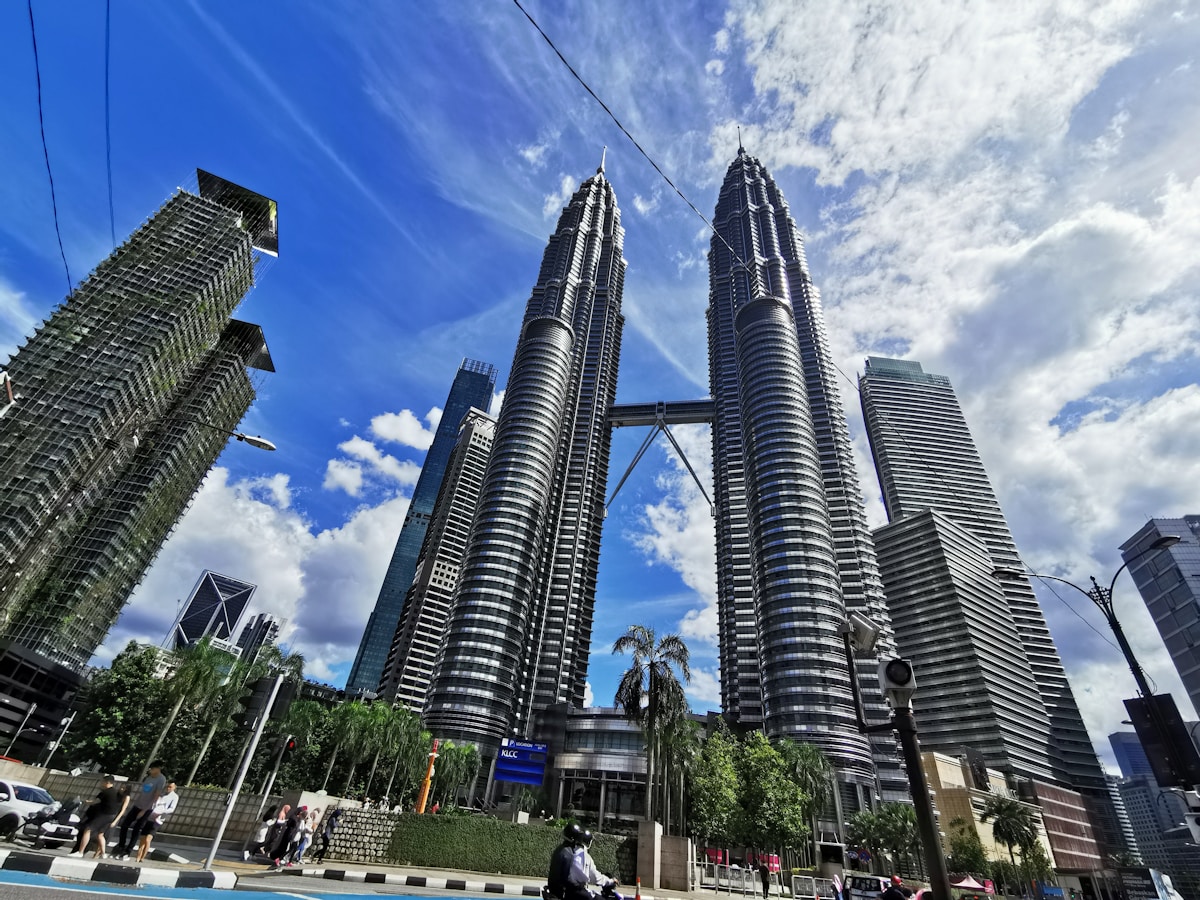
Kuala Lumpur has become a practical base for remote workers across a wide income range. The case for it is straightforward: English is the working language of business and widely spoken across service industries, internet infrastructure is fast and reliable, the cost of living is low relative to quality, KLIA is well-connected across Asia, and the city is easy to navigate once you understand the rail network. The food is excellent. The climate is warm year-round.
The main trade-off is heat and humidity - KL sits 3 degrees north of the equator, and outdoor comfort for long periods is limited. But the city is built for air conditioning. Getting around in it requires accepting that you will spend time in malls, covered walkways, and Grab rides rather than walking.
Monthly Costs
The following are realistic figures for a single person living comfortably in KL:
Accommodation: RM1,500–2,500/month for a furnished one-bedroom apartment in TTDI, Bangsar, or Petaling Jaya. More central areas (Bukit Bintang, Ampang, KLCC) run RM2,500–4,000. Shared accommodation brings this down to RM800–1,400. Most short-term leases run 3–6 months minimum; monthly rates are higher than annual contracts.
Food: RM800–1,200/month eating a realistic local diet - mamak stalls, hawker centres, and coffee shops for most meals, occasional restaurant dinners. RM1,500–2,500/month if you eat out regularly at mid-range restaurants, buy international groceries, and drink specialty coffee daily.
Coworking: RM400–700/month for a hot desk membership at Common Ground or Colony. Day passes at RM35–60 are good for lighter users.
Transport: RM200–400/month using a mix of Grab and rail. A Touch ‘n Go card for rail makes the LRT and MRT significantly cheaper. Grab within the city centre area runs RM6–18 per trip.
SIM card and data: RM30–80 for a 30-day tourist SIM from Maxis or Celcom with 20–50GB data. Long-term residents can register for a postpaid plan (Maxis Postpaid 60–100, RM60–100/month for unlimited data) with a foreign passport.
Total realistic monthly budget: RM3,000–5,500 (~$640–1,170 USD) for comfortable living. RM5,500–8,000 ($1,170–1,700 USD) if you want a nicer apartment, regular restaurant meals, and regular travel out of the city.
Best Neighbourhoods to Base Yourself
Bangsar is the most popular expat residential area for remote workers. It has the highest density of good independent cafes, international restaurants, and grocery stores (Jaya Grocer has everything). It is on the LRT (Bangsar station). It is quieter than KLCC and Bukit Bintang while still being urban. Rent for a one-bedroom runs RM1,800–3,000. The downside is that some parts are hilly and walking to the station requires a 10–15 minute uphill walk in heat.
TTDI (Taman Tun Dr Ismail) is a leafy residential neighbourhood about 8 km west of KLCC. It has less traffic than Bangsar, a smaller but good selection of cafes (including Pulp by Papa Palheta - the best specialty coffee cafe in the city), and a strong local food scene along Jalan Datuk Sulaiman. Common Ground’s most popular branch is here. Rent for a one-bedroom is RM1,500–2,500. The downside is the lack of direct rail access - you need Grab or a personal vehicle to reach the MRT or LRT.
Mont Kiara is the international family suburb northwest of the city centre. It has the largest expat community in KL (Korean, Japanese, and European residents in particular), international schools, and a dense retail and food offering. Apartments are typically larger than Bangsar equivalents. Rent for a one-bedroom starts at RM2,000 and averages RM2,500–4,000. Also lacks direct rail access.
Ampang / KLCC fringe gives you proximity to the city centre at slightly lower prices than staying in KLCC itself. A one-bedroom in Ampang runs RM1,800–3,000 and the Ampang Park MRT station is on the Putrajaya Line.
DE Rantau Digital Nomad Pass
Malaysia launched the DE Rantau Digital Nomad Pass in 2022. It allows remote workers to live in Malaysia for up to 12 months (extendable once to 24 months total). The requirements as of 2025:
- Employment income of at least USD 24,000/year (employed) or USD 24,000/year (freelance, requiring proof of client contracts or invoices)
- Remote work for a foreign company or clients outside Malaysia
- Valid travel insurance
- Application fee: RM1,000
Applications are processed through the Malaysia Digital Economy Corporation (MDEC) at nomad.mdec.com.my. Processing times have ranged from 2–8 weeks. The pass allows multiple entries and exit without losing status, and dependants can be added.
Without the DE Rantau pass, many remote workers enter on a standard 90-day visa-free stay and do a border run (Singapore is the most common option, a 5-hour bus or 30-minute flight) to reset. This is common but technically not a legal long-term solution, and Malaysian immigration has the discretion to question intentions on re-entry.
Internet and Connectivity
Fixed fibre broadband in apartments is widely available (Maxis, Time, Unifi). Speeds of 300–1,000 Mbps are standard for modern apartment connections. SIM-based mobile data is reliable throughout the city and in most suburban areas - 4G is universal, 5G coverage is expanding across KLCC, Bukit Bintang, and the major transit corridors.
Community
The KL digital nomad and expat community is active and reasonably well-organised. Facebook groups (Expats in Kuala Lumpur, Digital Nomads KL) have regular posts about housing, events, and practical questions. Meetups run through Meetup.com and through the coworking spaces - Common Ground and Colony both host networking events. The Bangsar and TTDI cafe circuits mean you encounter the same people regularly, which helps with building a working network quickly.
For a more focused look at the best cafes and coworking spaces, the KL cafes to work from guide covers specific venues, WiFi speeds, and day pass costs.
Get a Malaysia eSIM, Compare travel insurance, or Book airport transfers.
Related Guides
- Best cafes to work from in Kuala Lumpur - KLCC, Bangsar, and Bukit Bintang: specific venues with Wi-Fi speeds and day pass costs
- Malaysia digital nomad visa guide - DE Rantau pass: eligibility, application, costs, and what you need to qualify
- Best hotels in Kuala Lumpur - neighbourhood guide for choosing a long-stay KL base by commute and lifestyle
- Best cities for digital nomads in Malaysia - KL vs Penang vs Kota Kinabalu vs Johor Bahru compared for remote workers
- Malaysia SIM cards and internet - mobile data options, eSIM, and home broadband choices for long stays
For accommodation, search hotels in Kuala Lumpur on Booking.com.